A paddle level switch provides industrial plants with a straightforward solution to monitor solid material levels in silos, hoppers, and bins. These motor-driven devices use a rotating paddle mechanism that stops when material covers it and triggers a point level detection signal. You might call it a rotary paddle level switch, rotating paddle level switch, or paddle type level switch. The principle stays consistent in all applications. Industrial facilities value these rotary level sensors for their simple structure and proven reliability in harsh conditions, and they’re a budget-friendly option. We’ll explore how rotary paddle switches work and their main features. You’ll see why they matter so much in material handling operations.
What Is a Paddle Level Switch
Definition and simple function
A rotary paddle level switch is a mechanical device designed to detect the presence of solid materials in storage vessels like bins, silos, and hoppers. The device operates on a simple electromechanical measuring principle and suits almost all solids applications. A paddle type level switch has a rotating shaft with a paddle wheel or blade at its lower end, which is inserted into the material being monitored.
The simple function centers on a motor-driven paddle that rotates at a slow speed (around 1Hz) when no material is present. Bulk materials make contact with the paddle and resistance builds up. The rotation stops. This creates a counter-torque that triggers an electrical output signal through a relay or microswitch. The device can handle flowing bulk solids up to a grain size of 50mm (2″) and works with various material types that have powders, granules, and pellets.
The rotary paddle switch serves as a point level indicator that alerts operators when material stored in a vessel contacts the instrument. Plants wire these switches to alarms, lights, or control panels to signal high or low levels or to start and stop processes. The device provides a straightforward on/off signal rather than measuring the exact quantity of material present.
Point level detection vs continuous measurement
The difference between point level and continuous measurement helps clarify where paddle switches fit in the measurement landscape. Point level sensors detect whether material has reached a specific, predefined point within a container. They provide discrete signals that show high or low levels rather than a full range measurement. Point level devices work as switches that trigger a function when the tank level either rises or falls to a certain threshold instead of giving you constant feedback about material height.
Continuous level measurement provides up-to-the-minute monitoring of the exact material level over the full range of a container. These systems track incremental changes in material height and allow for precise inventory control. Continuous sensors deliver ongoing readouts that change as the material level changes. Point level switches only signal when a predetermined threshold is reached.
Rotary paddle level switches fall into the point level category. They’re deployed as full, empty, and just need alarms in silos with bulk solids. The switches detect high, mid, and low levels of material but don’t provide intermediate measurements between these points. This makes them ideal for overflow protection and low-level warning systems rather than precise inventory tracking.
Main components of a rotary paddle switch
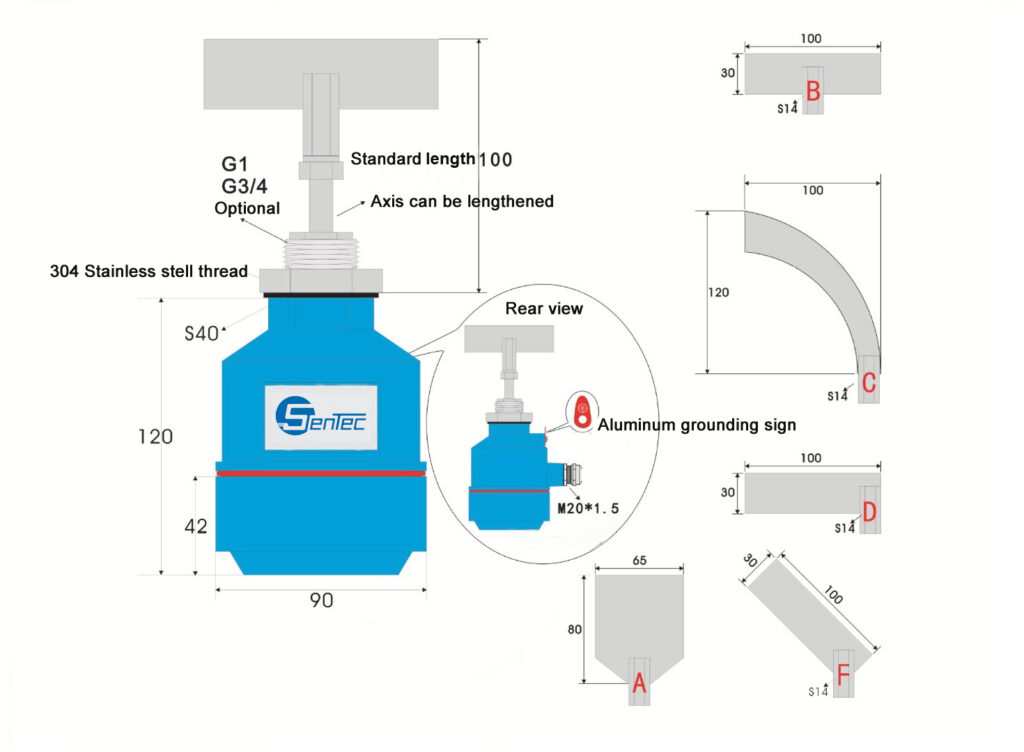
The construction of a rotating paddle level switch has several key elements working together:
Motor system: An electric motor drives the paddle at a consistent, slow rotational speed. The motor remains active as long as the paddle rotates freely.
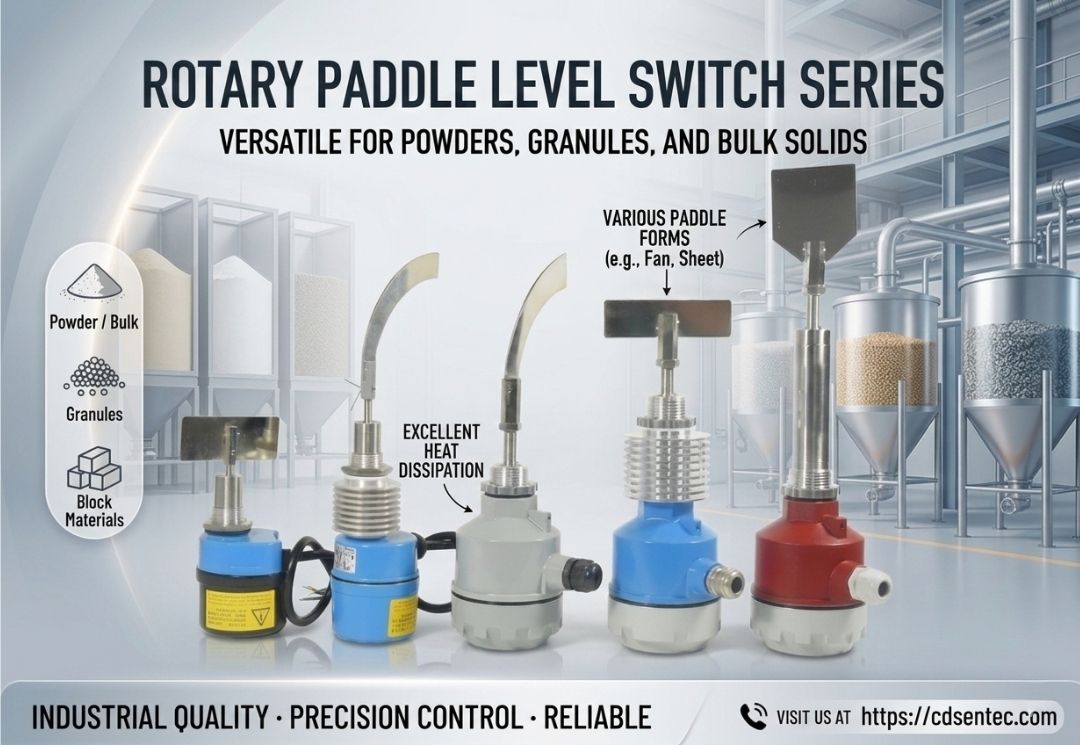
Rotating paddle or blade: The measuring blade extends into the material. Three-vane paddles are the most popular design and come in various diameters. Blade heights are made of stainless steel or nylon.
Shaft: Connects the motor to the paddle. Models come in different shaft lengths, from 100mm to 300mm for standard versions. Rope versions extend up to 2000mm.
Relay or microswitch: A mechanical component that provides electrical output when activated. The switch can be configured as normally open (NO) or normally closed (NC) contacts.
Housing: Reliable polymer housing with compact design protects internal components and is suitable to use in dust explosive areas.
The paddle encounters material and stops rotating. The hinge-mounted drive system changes position and triggers the microswitch. The level drops and material no longer covers the paddle. Spring force returns the drive to its original position and the microswitch restarts the motor.
How Rotating Paddle Level Switches Work
The motor-driven paddle mechanism
A synchronous motor rotates the paddle at 1 RPM during normal operation. The motor runs without stopping when no material is present and keeps the paddle in constant motion. Power consumption varies by model. Standard units typically draw 3W to 4W, though some DC24V versions draw 11W.
The motor mounts on a sliding-fit rotating disk connected to a spring. The spring remains relaxed when the paddle rotates freely, and the motor stays in its normal position. This spring-loaded arrangement is the foundation of the sensitivity mechanism that distinguishes between different material densities.
What happens when material covers the paddle
Resistance builds against the blade rotation as material rises and contacts the rotating paddle. The torque requirement increases and extends the spring connected to the motor assembly. Position sensors detect this spring extension and identify that material has reached the paddle level.
The motor stalls by design when the paddle becomes impeded by surrounding material. The internal clutch protects the motor from damage during this stall condition. Power cuts to the motor at this point to extend its operational life. The motor will remain stopped as long as material continues to cover the paddle.
The spring returns the motor to its original position where it can be powered on again when the material level drops and the paddle is no longer obstructed. The motor automatically restarts and resumes rotation.
Signal generation and switch activation
The rotary paddle switch contains two switches operating in complementary states. Normally closed (NC) contacts remain closed to COM when the paddle rotates freely without material contact, while normally open (NO) contacts stay open to COM.
The motor rotates on a switch actuating plate when material prevents the paddle from turning. This mechanical action flips both switches into their opposite states. NC contacts open to COM and NO contacts close to COM. Some modern designs use Hall-effect sensing to detect motor stall and trigger the relay change.
The relay provides clear signaling to operators and control systems. Visual indicators work with the switch states. Red lamps flash during free rotation and turn solid when material is present.
Sensitivity adjustment features
The paddle level switch can work with materials of very different densities through sensitivity adjustment. Most units ship with spring tension preset at mid-range sensitivity. This setting proves acceptable for most applications, assuming proper paddle selection.
Moving the adjustment to minimum spring tension enables switch actuation with less material restriction for very light materials (less than 10 lbs/ft³ or 160kg/m³). Reduced tension permits the paddle to respond to lighter bulk densities.
Maximum spring tension prevents false activations when material clears for very heavy materials (greater than 75 lbs/ft³ or 1200kg/m³) or materials prone to sticking. Some models offer 3-step sensitivity settings, while others provide 4-level torque selection through PCB switches. Certain designs include 5-speed adjustment mechanisms. Light powders suit lower torque settings, whereas higher settings handle denser materials without sweeping through them.
Key Features and Types of Paddle Level Switches
Standard rotary paddle level switches
Standard rotary paddle units feature industry-standard 1-1/4 male NPT connections with mounting flanges. The wetted components include 316 SS paddles and exposed shafts, PTFE shaft seals, aluminum mounting bosses, and 316 SS flexible couplings. Mounting flanges come in carbon steel or 316 SS depending on application requirements.
Temperature capabilities vary by construction type. Standard models handle process temperatures from -40 to 300°F (-40 to 148.9°C) with ambient ratings of -40 to 185°F (-40 to 85°C). High temperature options extend the process range to -40 to 500°F (-40 to 260°C). Certain specialized units reach up to 1100°C. Pressure ratings max out at 30 psig (2.07 bar) for materials with 0.5 micron or larger particle size.
Materials with densities of 10 lbs/ft³ and greater work with these switches. Electrical configurations include SPDT or optional DPDT snap switches rated at 15 A @ 120/230 VAC and 5 A @ 24 VDC. The control head alone weighs around 4 lb (1.81 kg).
Extended shaft and rope versions
Extended shafts provide the reach needed when top-mount installations require deeper insertion. Shaft extensions and guards come in galvanized steel or 316 SS construction. We recommend guards for shaft extensions exceeding 1 ft (0.3 m), and bracing becomes needed beyond 2 ft (0.7 m).
Flexible shaft couplings protect the paddle and drive mechanism from side loads, surges, and impacts. Top mount applications with shaft extensions benefit from these couplings, especially when you have large or heavy materials.
Rope versions offer field-adjustable solutions. Standard rope models extend up to 2000mm and can be cut to required lengths on-site. The strengthened rope versions maintain the same length capabilities while providing boosted durability. Tube versions serve as alternatives to rope configurations.
Compact and right-angled designs
Compact mini rotary switches address space constraints in smaller bins and hoppers. These economical units maintain rugged construction despite reduced footprints. The compact design suits applications where standard equipment won’t fit.
Right-angled mounting configurations enable side-wall installations through thick concrete silos. Horizontal extensions accommodate bin walls up to 12 inches thick and minimize damage risk during operations.
Material options for different applications
Paddle selection depends on material density and particle characteristics. Four-vane polycarbonate paddles handle light to medium density materials. Bayonet style polycarbonate paddles insert through ¾” pipe fittings for higher density applications. Stainless steel paddles suit corrosive environments where all wetted parts must resist chemical attack. Specialized rubber paddles detect EPS and EPP spheres when combined with appropriate sensitivity settings.
Why Industrial Plants Rely on Paddle Level Switches
Simple structure and budget-friendly
Paddle level switches operate without complicated electronic components or amplifier circuits. The internal design relies on straightforward mechanical action. This translates directly into lower manufacturing costs. Plants appreciate this cost-to-performance ratio and acquire reliable level detection without the premium pricing that more complex sensing technologies command.
High reliability in harsh environments
Rotary paddle switches withstand the demanding conditions common in bulk material handling. They manage abrasive, dusty and dense materials while maintaining consistent performance. The construction features double stainless-steel bearings. These prevent materials like salt and sugar from wearing out sensor seals and entering electronics. Reinforced shafts ensure high durability when contacting dense materials. Real-life implementations demonstrate this resilience. A peanut butter production plant experienced continuous, fault-free operation for 12 months after installing upgraded paddle sensors. This eliminated the frequent failures that previously required costly maintenance.
Easy installation and maintenance
Installation requires no calibration. Operators can mount the switch and begin monitoring immediately. This simplicity extends throughout the operational lifecycle. Paddle switches follow an “install and forget” principle, according to manufacturers. They function without ongoing adjustments. The straightforward mounting process and absence of complex setup procedures reduce deployment time and training requirements.
Strong anti-interference capability
Mechanical sensing renders these switches immune to electromagnetic interference. They operate whatever radio frequency noise, electrical equipment nearby, or electromagnetic fields that might disrupt electronic sensors. This immunity proves valuable in industrial environments. Motors, welders and high-voltage equipment create challenging electromagnetic conditions there.
Proven track record in industries of all types
Paddle switches deliver monitoring capabilities in grain silos, cement facilities, chemical plants and food manufacturing. Their performance spans decades of industrial use and establishes them as practical solutions that boost operational safety and reliability.
Common Applications of Rotary Paddle Switches
Grain silos and feed storage bins
Agricultural operations deploy rotary paddle switches throughout grain processing plants to monitor wheat, barley, rye, oats, and corn. Feed storage facilities use these sensors for flour, sugar, and other bulk food ingredients. The switches prevent ingredient shortages that interrupt production. They handle grain sizes up to 50mm (2″) and provide overfill protection with pinpoint empty detection.
Cement and fly ash monitoring
Construction industry storage silos rely on paddle switches for cement, aggregate, and roofing granules. Fly ash applications present challenges, with rotary paddle detectors managing temperatures reaching 600°C in collection vessels. These installations protect electrostatic precipitators and baghouse filters from material buildup that causes equipment failure.
Plastic granules and chemical hoppers
Plastic molding operations detect pellet levels in silos and hoppers using rotating paddle sensors. Chemical processing plants employ these switches for volatile, abrasive, or hazardous powders and granules in storage vessels, reactors, and tanks. Specialized rubber paddles handle EPS and EPP spheres.
Powder handling systems
Food manufacturing monitors powdered ingredients like cocoa, flour, and sugar. Pharmaceutical facilities use paddle switches during active ingredient mixing, tablet production, and medication packaging.
Full, demand, and empty detection scenarios
Paddle switches function as full, demand, or empty detectors depending on mounting position. High-level mounting prevents overfills. Low-level placement signals when to refill containers.
Conclusion
Rotary paddle level switches have earned their place as workhorses in industrial material handling, and with good reason too. Their mechanical simplicity translates into reliable performance without the complexity and cost of advanced sensing technologies. Plants in industries of all types trust these devices for critical level monitoring applications.
Paddle switches won’t suit every scenario, especially when you have sticky or very hard materials. But their proven effectiveness with most bulk solids makes them practical first-choice solutions. The straightforward installation and minimal maintenance requirements demonstrate why this classic technology continues serving modern industrial operations. Decades of field-proven reliability back up this claim.
These devices are immune to electromagnetic interference. This will give consistent performance where electronic sensors might struggle.