What is mass flow meter? A mass flow meter measures the mass flow rate of fluids moving through pipes. Unlike conventional flow meters that measure volume, it gives accurate mass measurements. This difference matters a lot when you work with fluids that have varying density, as volume measurements alone can mislead.
Mass flow measurement serves as the foundation for recipe formulations, material balance calculations, billing, and custody transfer operations in many industries. Two types of mass flow meters stand out because of their unique capabilities. Coriolis mass flow meters deliver high accuracy between 0.1% and 0.5% for mass flow measurement, density, temperature, and viscosity. Thermal mass flow meters work best with very low gas flow rates—from 0.5Nm/s to 100Nm/s—which other devices can’t detect[-3]. These thermal meters give consistent readings regardless of changes in viscosity, temperature, pressure, or density.
This detailed guide will help you understand mass flow meters, their types, working principles, and the best way to select one that fits your needs.
What is a Mass Flow Meter and Why It Matters
Mass flow meters are vital instruments that measure fluid mass passing through a system over time. These devices offer better reliability than volumetric meters because they measure the actual material quantity moving through a system. The measurements stay accurate even as conditions change.
Mass flow vs volume flow: key differences
Mass flow shows the actual number of molecules moving through a system. Volumetric flow measures the physical space a fluid takes up. This difference matters a lot in real-world applications.
Mass flow measurement brings several benefits:
Consistency despite changing conditions – Mass stays constant even with temperature and pressure changes. This means mass flow readings remain accurate as conditions shift
Direct correlation with substance quantity – Mass flow matches the actual amount of material measured, which makes it perfect for precise applications
No need for compensation – Mass flow meters don’t need extra temperature and pressure measurements that volumetric meters require
Volumetric flow rates change when temperature and pressure vary because these factors change fluid density. Gas volume changes substantially under different conditions. This makes volumetric measurements less reliable for high-precision needs.
Where mass flow measurement is used
Mass flow meters have taken over other flow rate measurement techniques in many industries because of their high accuracy.
Chemical processing plants use these devices to measure chemical and gas flow rates. This ensures exact mixing and dosing during manufacturing. Food and beverage companies need them to track ingredients and final products with great precision.
On top of that, mass flow meters are a great way to get results in:
Oil and gas operations that measure crude oil, natural gas, and pipeline hydrocarbons
Aerospace applications that track fuel consumption in aircraft engines
Environmental monitoring to meet regulations
Pharmaceutical manufacturing to maintain product quality
HVAC systems to optimize energy efficiency
Mass flow measurements play a vital role in billing, custody transfer operations, and material balance calculations. These meters deliver the accuracy needed for consistent results and quality products, especially in processes that depend on exact molecular quantities like chemical reactions.
How Mass Flow Meters Work
Mass flow meters use several distinct physical principles to capture the substance mass flow directly. This technology enables remarkable accuracy in applications of all types.
Coriolis effect and inertial measurement
Coriolis flow meters work on motion mechanics principles. These devices use vibrating tubes that twist slightly as fluid flows through them. The fluid enters the sensor and splits into oscillating tubes that a drive coil stimulates at their natural resonant frequency. The sensors on the vibrating tube measure a phase movement that becomes directly proportional to the mass flow rate.
Fluid particles flowing through the oscillating tube experience a measurable twist from the Coriolis effect. This physical phenomenon happens because fluid entering the tube accelerates toward peak amplitude vibration points and decelerates while exiting. The tube deflection creates a time delay between sine waves (Delta-T) that matches the mass flow precisely. The vibration frequency measures density independently, since denser fluids make the vibration frequencies lower.
Thermal mass flow principles
Thermal mass flow meters employ heat transfer principles to measure flow. These devices use two temperature sensors – a reference sensor that measures fluid temperature and a heated flow sensor that stays at a specific temperature above the reference.
Heat absorption forms the core operating principle. Gas flowing past the heated sensor pulls heat from the sensor’s surface. The power needed to keep this temperature difference associates with the mass flow rate. This creates a cooling effect in gasses that matches the number of molecules touching the heated surface. The measurements remain independent from pressure and temperature changes.
Other working mechanisms
Mass flow measurement uses several other mechanisms. Some differential pressure mass flow meters detect pressure differences across flow path constrictions. These devices work with volumetric flow meters (magnetic, ultrasonic, turbine) to calculate mass flow indirectly through temperature and pressure sensors.
Mass flow meters share one fundamental trait – they measure the actual molecules passing through the system rather than just the space they take up.
Types of Mass Flow Meters Explained
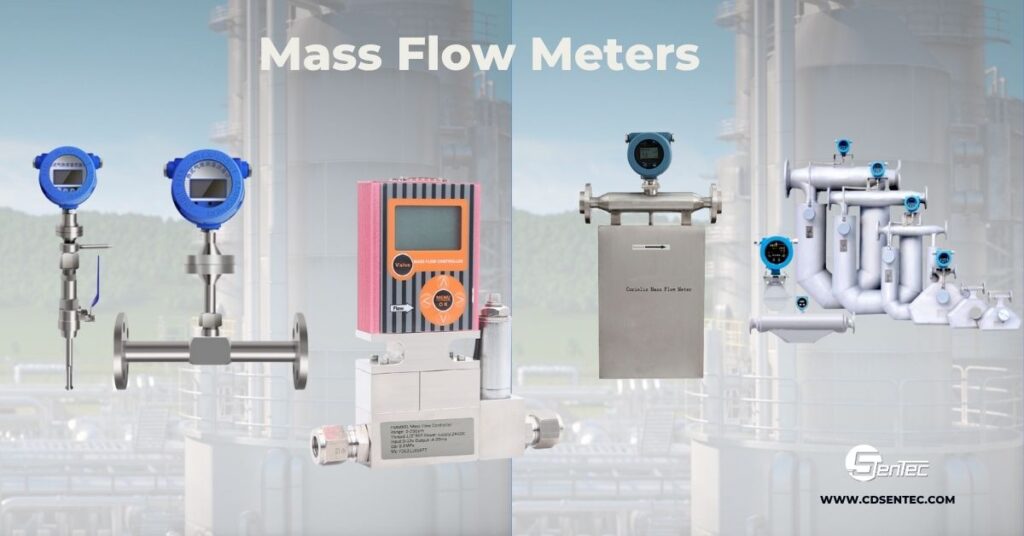
Mass flow meters exist in several distinct types, and each one works on different physical principles to measure mass accurately. Let’s look at the four main types.
Coriolis mass flow meters
Coriolis meters measure mass through inertia by using tubes that vibrate and twist slightly as fluid moves through them. These devices reach remarkable accuracy between 0.1% and 0.5%, which makes them the most precise flow measurement technology we have today. They work great with both gasses and liquids and can measure density and temperature at the same time. The meters might not work as well when bubbles appear in liquids because they create “splashing” that adds noise and affects the readings.
Thermal mass flow meters
Thermal meters work by measuring how heat transfers from a heated surface to the moving fluid. They keep a steady temperature difference between two sensors, and the power needed to maintain this gap shows the mass flow directly. These meters are particularly good at measuring very low gas flow rates—as low as 0.5Nm/s and up to 100Nm/s.
Impeller turbine meters
Impeller turbine meters use two rotating parts—a turbine and an impeller—placed in the fluid stream. A synchronous motor drives the impeller at constant speed and gives the fluid angular velocity. The turbine downstream receives torque that matches the angular momentum, and the spring’s deflection measures mass flow.
Twin turbine meters
Twin turbine meters work on fluid inertia principles. They have two turbines with different blade pitches joined by a flexible connection. These meters measure the differential torque that builds up between the wheels as fluid passes through. The mass flow increases create bigger angular gaps between the turbines.
Applications and Limitations in Real-World Use
Mass flow meters excel in many real-life applications though they face specific operational challenges. You need to understand their capabilities and limitations to select the right one for your industrial needs.
Industrial and chemical process control
Thermal mass flow meters lead the industrial processing sector because of their design advantages. These meters work without moving parts, need no temperature or pressure corrections, and stay accurate across wide flow ranges. Chemical processing plants use these instruments to control reaction kinetics precisely and keep product uniformity stable by maintaining accurate stoichiometric ratios. The pulp and paper industry depends on them to track compressed air, natural gas consumption, and combustion air. These meters help teams figure out when and where compressed air gets used, so they can spot waste and make operations run better.
Gas flow and combustion monitoring
Mass flow meters solve air-to-fuel tuning problems by providing accurate, repeatable measurements. Maintenance engineers can calculate the best air-to-fuel ratios by tracking both fuel and airflow to each burner. This approach saves fuel and helps cut emissions. The U.S. Department of Energy points out that better thermal combustion in burner control offers a big chance to cut energy costs. This is a big deal as it means that inefficient systems feed too much combustion air by up to 20 percent.
Common limitations and challenges
Mass flow meters are versatile but face several challenges. Measurement spikes and errors happen when condensed moisture touches heated sensors. Teams can alleviate this issue by installing knockout drums or angling flow sensors. These meters also become less sensitive at higher velocities, especially in compressed gas systems over 150 PSI. Calibration presents another hurdle—some manufacturers want factory recalibration, which costs more and takes time.
Environmental and material factors
External factors affect measurement accuracy by a lot. Electronic components and differential expansion between meter body and measuring tubes can throw off readings when ambient temperature changes. Teams can minimize vibration effects by paying attention to installation details. Multiple instruments of the same model in series should have staggered working frequencies to avoid interference. Material choice becomes crucial when working with corrosive chemicals or abrasive slurries. Electromagnetic flowmeters work in many applications, but teams must verify material compatibility through actual operating condition tests.
Conclusion
Mass flow meters are a major step forward in fluid measurement technology. These specialized devices measure the actual mass of fluid that passes through a system. They don’t just measure volume, which makes them more reliable whatever the temperature or pressure conditions might be.
Measuring mass flow versus volume becomes especially important with fluids that have varying density. Volume readings change when conditions shift, but mass flow stays constant. This eliminates the need to use compensation factors that you’d need with volumetric meters.
Two main technologies dominate this field: Coriolis and thermal mass flow meters. Coriolis meters deliver outstanding accuracy between 0.1% and 0.5%, which makes them perfect for precise applications in any industry. Thermal mass flow meters shine at measuring very low gas flow rates that other devices can’t even detect.
These instruments have changed how industries track and control fluid movement, from chemical processing to food production, oil and gas operations to pharmaceutical manufacturing. They are a great way to get accurate measurements even when conditions change, which helps with billing, custody transfer, and material balance calculations.
You should think over several factors before picking a mass flow meter. These include fluid properties, accuracy needs, installation environment, and potential limits. Measurement accuracy can suffer from challenges like moisture condensation, vibration effects, and material compatibility if they’re not handled properly.
Mass flow measurement benefits clearly outweigh the drawbacks for most industrial uses. Industries just need more precision, reliability, and better efficiency. That’s why mass flow meters will stay the top choice for accurate fluid measurement in many sectors.