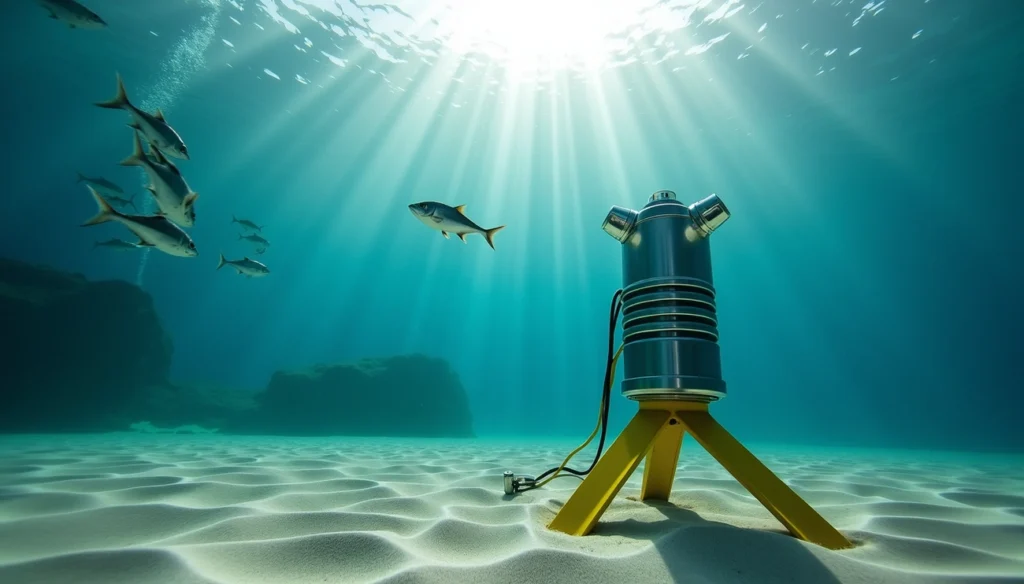
Acoustic doppler current profilers have transformed water movement measurement by capturing data at multiple depths simultaneously, not just at a single point. These sophisticated instruments, once anchored to the seafloor, measure current speeds from bottom to surface and create a detailed profile of water movement.
The acoustic doppler current profiler (ADCP) has become crucial for understanding water dynamics everywhere from shallow streams to the deepest ocean trenches. Higher frequency ADCPs (300 kHz) deliver precise data near the surface to depths of about 70 meters. Lower frequency models (38 kHz) can reach depths of up to 1,300 meters. These doppler instruments can operate underwater for years, with battery life being their only limitation. The devices use frequencies ranging from 38 kHz to several megahertz and employ the doppler effect in water to measure flow patterns accurately in a variety of aquatic environments. Acoustic doppler current profiler manufacturers like Teledyne RD Instruments have made these devices the standard for quality and reliability over the past 40 years. Their applications range from river discharge measurement to hydroelectric power planning.
Let’s take a closer look at ADCPs—their inner workings, deployment strategies, data processing capabilities, and real-life applications in different water environments.
How an Acoustic Doppler Current Profiler Works
The science behind acoustic doppler current profilers stems from a basic physics principle that anyone who has heard a passing ambulance understands. ADCPs use the Doppler effect in water differently than the familiar change in ambulance siren pitch. They transmit acoustic “pings” at a constant frequency and analyze the returned echoes.
The Doppler effect in water explained
Relative motion between a sound source and listener creates the Doppler effect. This principle becomes especially useful to measure currents in water. Sound waves travel through water at approximately 1481 meters per second at 20°C. The speed varies slightly based on temperature, pressure, and salinity. ADCPs measure tiny frequency changes in acoustic signals as they bounce off moving particles to utilize this predictable property.
How sound waves measure current velocity
ADCPs send sound pulses into the water column through piezoelectric transducers. The sound waves bounce off particles and return to the instrument with an altered frequency. Particles moving toward the profiler send back higher-frequency echoes. Those moving away produce lower-frequency returns. The instrument calculates water velocity using the formula: Fshift/n = 2 × cosθ × Fsource × (Vn/C). Here, Fshift represents frequency change, Fsource is emitted frequency, Vn shows water velocity, C indicates sound speed, and θ represents the angle between sensor and flow direction.
Role of suspended particles in velocity detection
ADCPs don’t measure water movement directly. They measure the velocity of tiny particles suspended in the water. These particles, which include zooplankton, sediment, or organic matter, move at similar speeds as the surrounding water. The device needs these natural acoustic backscatterers throughout the water column to take accurate measurements. It divides the water into discrete “bins” or layers and collects velocity data from each one. The ADCP uses multiple acoustic beams, typically four positioned at 30° from vertical, to resolve current velocity’s three-dimensional components. This clever application of physics allows a single instrument to create complete current profiles from surface to bottom.
Mounting and Deployment Options
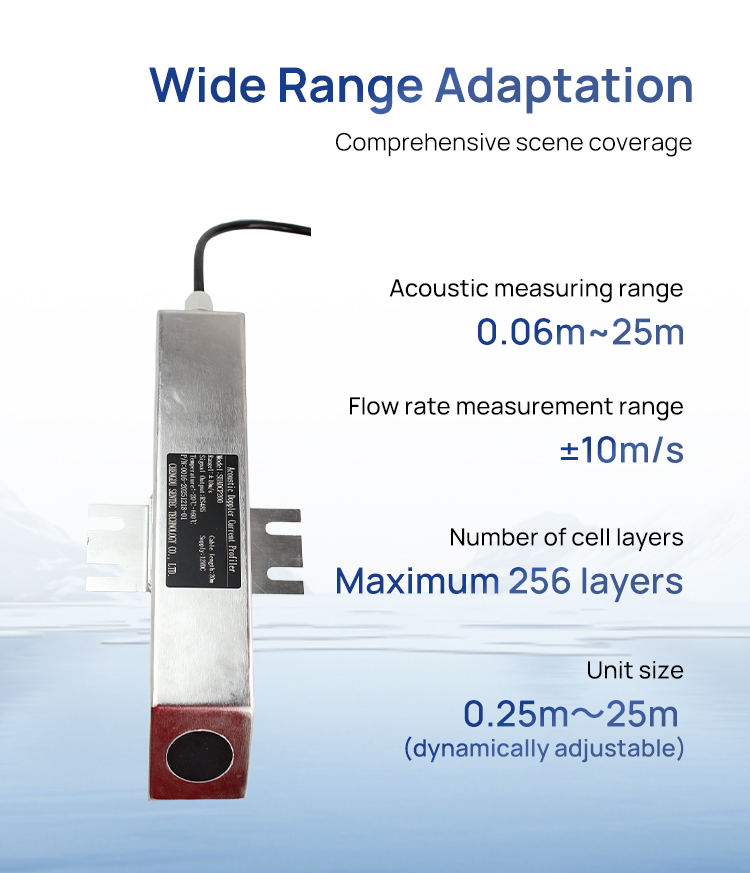
The quality of your acoustic doppler current profiler data depends significantly on choosing the right mounting strategy. Different deployment methods provide unique benefits that match specific monitoring needs.
Bottom-mounted vs. vessel-mounted ADCPs
Bottom-mounted ADCPs rest firmly on the seafloor or riverbed and typically face upward for long-term monitoring. These stable seabed platforms deliver high-quality current profiles over extended periods, which makes them perfect for tidal resource surveys and sediment dynamics research. Vessel-mounted profilers collect current data while moving, either through hull mounts or side frames—an ideal setup for coastal current mapping and river discharge measurements. Shallow streams benefit from bottom-mounted tripods that position the ADCP about 65 cm above the riverbed to measure nearly the entire water column.
Upward, downward, and side-looking configurations
Your ADCP’s orientation plays a vital role in data quality. Bottom-mounted deployments work best with upward-looking configurations that measure from seafloor to surface. Vessels and underwater vehicles commonly use downward-looking setups to profile from surface to bottom. Side-looking arrangements fit specialized cases that need horizontal profiling. Your measurement goals and environmental conditions should guide the configuration choice. Precise calibration of mounting angle and alignment ensures accurate velocity measurements.
Choosing the right frequency for depth and resolution
Frequency selection balances range against resolution. Higher frequencies (1000-2000 kHz) excel in shallow waters with detailed measurements but reach only 2-25 meters with 0.1-0.2 meter resolution. Mid-range frequencies (600 kHz) achieve 40-80 meter ranges with 0.5-meter resolution—perfect for tides and internal waves. Lower frequencies (75-300 kHz) reach deeper waters (80-800+ meters) but trade off resolution (1-10 meters). The instrument’s frequency determines minimum cell size and blanking distance, which are key parameters for accurate profiling.
Environmental considerations for installation
The installation environment heavily affects ADCP performance. Marine deployments need anti-fouling treatments to stop biological growth that degrades data quality and increases mooring drag. Vessel installations should position the transducer away from bubble layers that scatter and absorb sound waves. The best installation spots avoid backflow areas and keep beam paths clear of obstructions. High-frequency instruments show more sensitivity to moving-bed issues than their low-frequency counterparts.
Data Collection and Processing
ADCPs convert raw sound echoes into valuable water movement data through a sophisticated process of collection and analysis after deployment.
How ADCPs create current profiles
ADCPs split the water column into specific segments called “range cells” or “bins”. The instrument processes returning echoes from suspended particles in sequence, starting with the nearest and moving to the farthest. A single ping sequence produces a complete velocity profile. Most ADCPs use three to four beams pointed in different directions to determine three-dimensional velocity. Multiple beams measure different velocity components at the same time, which convert through trigonometric relations into complete current profiles.
Understanding cell layers and resolution
Cell size configuration balances measurement detail against data quality. Shorter cells provide better spatial detail but increase velocity variance. Users can adjust the range cell size on most ADCPs, though the cell size stays constant throughout the profile once set. The standard deviation of measurements drops proportionally to the square root of averaged pings. Averaging multiple pings reduces variance but leads to lower temporal resolution.
Real-time vs. stored data output
Bottom-mounted ADCPs need internal data loggers to store measurements until retrieval. Vessel-mounted systems link to shipboard computers and provide immediate data access. Vessel operations require GPS navigation systems to work with the ADCP. This setup removes the ship’s movements from current data. Raw measurements go through quality control screening before analysis. This process includes correlation tests, false target rejection, and error velocity assessments.
Software tools for data visualization
Scientists have many software options to process and visualize ADCP data. The Velocity Mapping Toolbox (VMT) quickly processes transect data and exports to ArcGIS, Tecplot, and Google Earth. Echoview Software focuses on processing echosounder data from Nortek Signature ADCPs. Python with matplotlib creates publication-quality plots, while GMT generates vertical sections. These tools help researchers spot patterns in three-dimensional fluid motion and analyze both acoustic backscatter and bathymetric data effectively.
Applications from Streams to Oceans
ADCPs are great tools that work in all types of water environments, from shallow streams to deep ocean waters. These versatile instruments support scientific research, environmental monitoring, and vital operational safety measures.
River discharge and flow monitoring
ADCPs stand out in measuring unsteady and bidirectional flows where conventional current-meter methods struggle. They can track dramatic discharge changes during tidal events where flow can move by more than 100% in just 10 minutes. ADCPs boost accuracy by sampling larger portions of the water column. This makes them valuable tools to develop index velocity ratings at sites where flow conditions change faster.
Ocean current and wave studies
Oceanographers rely on ADCPs to track how water movements carry organisms, nutrients, and other materials through marine environments. The detailed data they collect helps scientists measure heat transport in areas like the Gulf Stream, which affects Earth’s global climate. Some ADCPs can even measure surface wave height and direction through vertical beams that track distance to the surface.
ROV and AUV navigation support
ADCPs help underwater vehicles navigate with bottom tracking features. These work alongside position fixes, compass headings, and acceleration sensors—usually combined through Kalman filters—to calculate vehicle position. Autonomous underwater vehicles and gliders need lightweight, low-power ADCPs to control altitude and plan adaptive missions.
Climate and sediment transport research
Scientists use ADCP technology to study ocean heat transport—a vital part of Earth’s climate system. Researchers also analyze backscatter values from ADCP signals to estimate suspended sediment concentration, which allows immediate observation of sediment transport. This helps develop sediment budgets during flooding events when traditional sampling methods fall short.
Safety planning for marine operations
Offshore operations benefit from ADCP data to reduce risks during construction activities. These devices provide immediate current mapping to support precise crane operations, efficient pipe-laying, and diver safety in challenging marine environments. They also help plan dives and ensure safe ROV deployment and recovery, especially in areas with complex current patterns.
Conclusion
Acoustic doppler current profilers showcase how sound-based technology reshapes the scene of water movement studies. These sophisticated instruments create detailed profiles in a variety of aquatic environments that conventional methods can’t match. The science behind ADCPs utilizes basic physics principles. They send sound waves through water and analyze returned echoes to build complete three-dimensional pictures of complex flow patterns.
The quality of data depends on choosing the right mounting strategies, frequencies, and configurations. Bottom-mounted systems work best to get stable long-term readings, while vessel-mounted options make it easier to map larger areas. Higher frequencies excel at detailed shallow-water measurements. Lower frequencies can reach hundreds of meters below the surface.
Data processing capabilities have improved by a lot over four decades. Researchers can now see current patterns with amazing clarity. Modern software tools convert raw acoustic signals into useful information about water movement. This technology has found its way into many disciplines.
ADCPs’ practical value reaches way beyond the reach and influence of academic research. These instruments help track ocean heat transport for climate studies and let engineers plan safe marine operations in tough conditions. Scientists get reliable sediment transport data during floods when traditional sampling doesn’t work. ADCPs also guide underwater vehicles through complex environments with precise navigation.
Acoustic doppler current profilers are vital tools that help us understand water dynamics from shallow streams to the deepest ocean trenches. Their ongoing development will reveal more secrets about Earth’s most precious resource.