A millimeter wave radar level sensor can detect movements as small as a fraction of a millimeter. This makes it one of the most precise technologies for industrial tank measurement. These sensors operate between 30 GHz and 300 GHz, and the choice between 26 GHz, 60 GHz, and 80 GHz frequencies substantially impacts measurement accuracy, installation requirements, and cost.
In this piece, we’ll walk you through the technical differences between these three mmwave sensor frequencies. We’ll get into how each millimeter wave radar performs in ground applications, from 60ghz radar systems in powder storage to high-precision 80 GHz installations. On top of that, we’ll explore how radar waveform characteristics, antenna design, and frequency selection affect your tank level measurement outcomes.
Understanding mmWave Radar Technology for Tank Level Measurement
What is Millimeter Wave Radar
Millimeter wave radar refers to electromagnetic sensors operating between frequencies of approximately 30 MHz to 300 GHz, with industrial tank level applications using 24, 60, or 80 GHz. The wavelength of these signals gives us the term “millimeter wave.” A 26 GHz radar produces an 11.5mm wavelength, while 80 GHz gets a 3.75mm wavelength. This non-contact measurement technology emits electromagnetic waves downward toward liquid or solid surfaces and then calculates distance based on the reflected signal.
The mmwave sensor principle offers distinct advantages over contact-based methods. The electromagnetic waves propagate through dust, vapor, foam, and temperature variations without signal degradation. Process conditions like density, viscosity, conductivity, and coating don’t affect measurement accuracy. Industrial systems can measure distances from a few centimeters up to 40 meters with ±1-5mm precision.
How FMCW Radar Works in Level Sensing
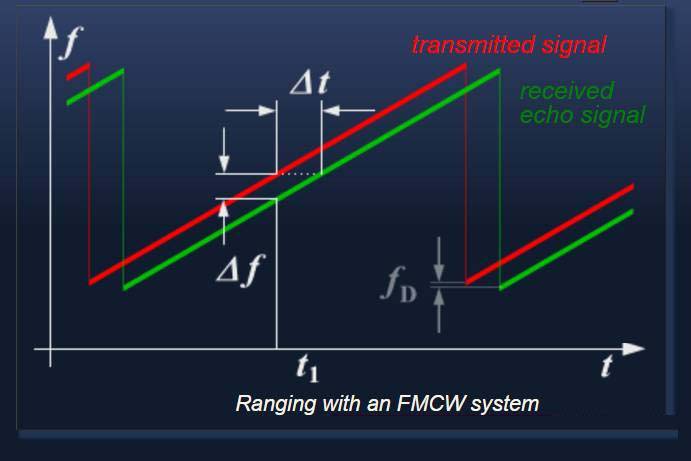
Frequency Modulated Continuous Wave technology transmits an uninterrupted signal where the frequency changes over time and creates a frequency sweep. The system sends out a signal at a starting frequency and then increases it to an upper frequency limit. This is fundamentally different from pulse radar that sends discrete bursts.
The continuous wave reflects off the liquid surface and returns to the antenna with a time delay. The system mixes the transmitted signal with the received signal and produces what engineers call a “beat frequency”. This beat frequency represents the difference between what’s transmitted right now and what was transmitted earlier and then reflected back.
The relationship is straightforward: Distance = (Speed of light × Beat frequency) / (2 × Sweep rate). FMCW sensitivity surpasses traditional pulsed radar transmitters by more than 30 times. A practical example demonstrates this precision: in a 17m tank experiencing temperature swings from -48°C to +70°C, FMCW radar maintains measurement stability with maximum error of just ±0.5mm. The system’s blind zone measures less than 5cm.
Why Frequency Matters in Tank Applications
The operating frequency determines beam angle, measurement accuracy, and antenna size requirements. Higher frequencies produce shorter wavelengths and result in narrower, more focused beams. This becomes critical in tanks with internal obstacles or small installation openings. Frequency selection also affects how well the radar penetrates through vapors and foam layers and influences reliability in challenging process conditions.
26 GHz vs 60 GHz vs 80 GHz: Complete Technical Comparison
Selecting between these frequencies requires understanding how each performs in parameters of all types. The following comparison illustrates the technical trade-offs:
Wavelength and Beam Angle Differences
| Parameter | 26 GHz | 60 GHz | 80 GHz |
| Wavelength | 11.5mm | 5mm | 3.75mm |
| Beam Angle | 8°–25° | 6°–12° | 2°–6° |
| Measurement Accuracy | ±10–20mm | ±5–10mm | ±1–3mm |
| Blind Zone | 0.3–1m | 0.2–0.5m | 0.08–0.2m |
| Antenna Size | Large | Medium | Small |
Measurement Accuracy and Blind Zone
The 80 GHz radar achieves exceptional precision and detects materials from 98 feet away with millimeter resolution. Its blind zone measures just 80–100mm for liquids and shrinks to 40–80mm in optimized short-range models. The 26 GHz systems require 300mm to 1m of clearance, which limits their use in shallow vessels.
Antenna Size and Installation Requirements
Higher frequencies have an advantage when installation constraints matter. A G1-½” (40mm) lens antenna at 80 GHz delivers beam focus equivalent to a 4″ (100mm) horn at 26 GHz. The 26 GHz systems need DN100 or DN150 flanges for DN50 installations, while 80 GHz fits smaller openings.
Anti-interference Capability
Harsh environments favor lower frequencies. The 26 GHz radar penetrates dust and steam and remains stable under vapor and foam conditions. The 80 GHz suffers signal attenuation from condensation and agitated surfaces despite its narrow 3° beam.
Price and Cost Analysis
Technological sophistication determines cost. The 26 GHz sensors represent the most economical option and 60 GHz occupies mid-tier pricing, while 80 GHz commands premium rates.
Market Trends in 2026
K-band (24–26 GHz) held 37.40% of 2025 shipments. W-band frequencies show 7.18% CAGR growth. The radar level transmitter market reached USD 606.11 million in 2025 and is projected to hit USD 640.63 million in 2026. Technology migration from ultrasonic to 80 GHz radar accelerates European oil terminal upgrades.
Frequency Selection Guide for Different Applications
Material properties dictate frequency selection more than any other factor. The dielectric constant of the measured substance determines signal reflection strength and measurement reliability.
26 GHz Radar for Water and Liquid Level Monitoring
Water and high-dielectric liquids work well with 26 GHz systems. With a dielectric constant of 80, water produces strong reflections that 26 GHz pulse radar detects up to 98 feet with high reliability. River, reservoir, and open water monitoring applications benefit from this frequency’s balanced beam angle and economical pricing. Environments without internal obstacles allow for straightforward installation. This makes 26 GHz suitable for wastewater treatment, bulk storage tanks, and neutralization vessels.
60 GHz Radar for Powder and Bulk Material Storage
Short-range powder applications find an ideal match in 60 GHz technology. This frequency achieves sub-2 cm spatial resolution at distances less than 20 cm. The compact antenna design fits confined spaces and maintains measurement precision for grain, pellets, and aggregate materials. Material classification systems operating at 60 GHz demonstrate 97% accuracy across ten different substances.
80 GHz Radar for High-Precision Industrial Tanks
Chemical storage demands the precision that 80 GHz delivers. An 80 GHz radar achieved ±1mm accuracy in a titanium tetrachloride tank application despite corrosive fumes and complex internal structures. The narrow 3° beam angle avoids interference from agitators and heating coils that defeat lower frequencies. Tall vessels up to 394 feet and narrow silos benefit from the focused signal transmission.
Powder Material Measurement: Which Frequency Performs Better
Low-dielectric powders require careful frequency selection. Materials like fly ash (dielectric constant 1.8-2.5) and plastic pellets need either 80 GHz sensors or horn antennas at lower frequencies. Similarly, benzene with its 2.3 dielectric constant demands high-sensitivity 80 GHz radar. Molasses (dielectric constant 31.3) works with any frequency, in contrast.
Installation and Real-World Performance Considerations
Small Diameter Installation (DN50 and Below)
Process fittings smaller than DN50 historically required larger radar sensors. Previous radar technologies needed minimum 1½” fittings for adequate signal focusing. An 80mm antenna operating at 80 GHz produces a 3° beam angle and enables smaller dimensions for both antenna systems and process fittings. This frequency fits installations where 26 GHz systems need DN100 or DN150 flanges.
Tanks with Internal Obstacles (Stirrers, Ladders, Heating Pipes)
Internal structures create measurement challenges through false echo generation. A radar beam at 80 GHz reflects only from the product surface. Wider 26 GHz beams also reflect from internal fixtures and agitators. Advanced transmitters employ Smart Echo Supervision, which reviews all viable echoes immediately rather than requiring manual false echo suppression routines. Mount sensors off-center from dome tops and away from ladders and mixers.
River, Reservoir and Open Water Monitoring

Open water applications require vertical sensor alignment within 1° to prevent trigonometric measurement errors. The sensor must maintain minimum 0.4 meters clearance from the water surface. Installation locations should avoid rapid fluctuations and turbulence, as measurement results derive from 20-second averaging periods. Radar water level sensors achieve ±1mm accuracy under suitable conditions.
Algorithm and Antenna Design Effect on Measurement
Signal processing algorithms filter interference from moving parts and ignore false echoes caused by obstructions. Antenna feeding networks with optimized power dividers reduce sidelobe levels by up to 5 dB in specific directions. Special software algorithms compensate for product buildup on antenna systems and maintain reliable detection even with sensor contamination.
Conclusion
Choosing the right millimeter wave frequency for your tank level measurement requires balancing precision needs against budget constraints. We recommend 26 GHz for straightforward liquid applications where cost matters most and 80 GHz when measurement accuracy and narrow beam angles are non-negotiable. Powder storage that needs compact design works well with 60 GHz. Review your specific material properties, installation constraints and internal obstacles before making your investment. The right frequency selection will deliver reliable measurements for years and avoid pricey modernization later.