Traditional measurement devices fail at the time they encounter slurries, highly viscous fluids, or abrasive media. That’s where a wedge flow meter becomes necessary. Standard flow meters often clog, erode quickly, or lose accuracy when faced with these challenging conditions. Wedge meters are engineered to handle dirty, contaminated, or solids-containing fluids that would render other technologies ineffective. The Rosemount 9195, for example, delivers adjusted accuracy of 1.0% while handling temperatures up to 1000°F (538°C) and pressures up to ANSI B16.5 600#. In this piece, we’ll walk you through the wedge flow meter working principle, selection factors including wedge type flow meter configurations, wedge meter flow calculation aspects, and proven applications where this technology excels.
What is a Wedge Flow Meter and How Does It Work
Wedge Flow Meter Working Principle
Wedge flow meters operate on differential pressure measurement and use principles derived from Bernoulli’s equation and energy conservation. The core mechanism involves a V-shaped restriction embedded within the meter body that constricts the available flow area. At the time fluid passes over this restriction, the flow velocity increases while static pressure decreases. This creates a measurable pressure differential between the upstream and downstream sides of the wedge.
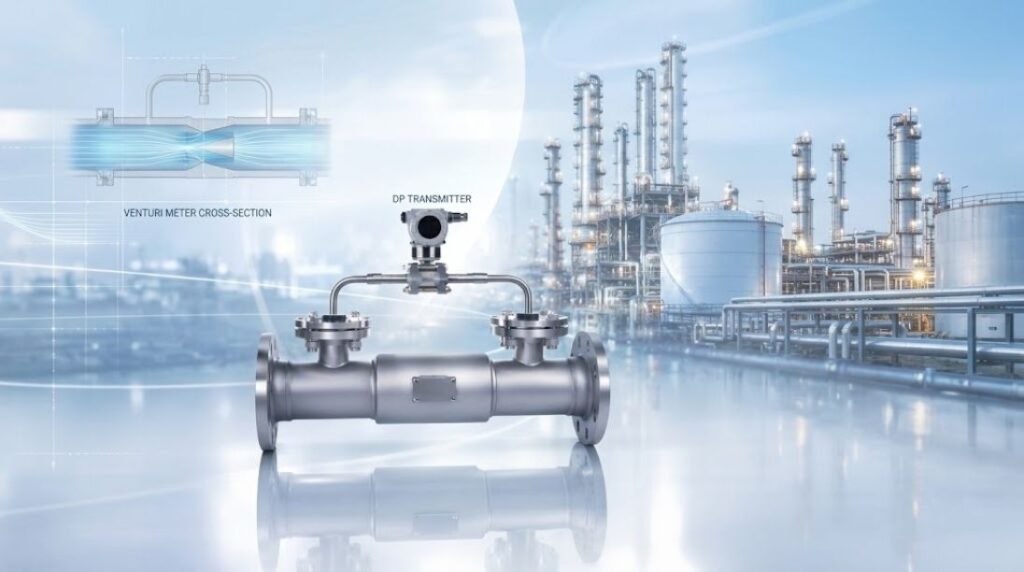
Pressure taps positioned on either side of the restriction capture this differential pressure and connect it to a differential pressure transmitter. The relationship between differential pressure and flow rate follows a square root function. This allows us to calculate volumetric flow from the pressure readings. What sets wedge meters apart is how they maintain this relationship across flow regimes. Most differential devices are limited to Reynolds numbers of 20,000 and greater. Wedge meters deliver linear and accurate measurements down to Reynolds numbers of 500. This capability extends well into the laminar flow zone and makes them work for both highly viscous fluids and low-flow applications.
Key Design Components
The H/D ratio defines the wedge meter’s measurement characteristics. This ratio equals the height of the opening below the restriction (H) divided by the internal pipe diameter (D). We can achieve the desired differential pressure for specific flow rates by varying this ratio. This allows optimal balance between purchase cost and acceptable pressure loss. A calibrated wedge meter achieves 0.5% uncertainty, while an uncalibrated unit operates at 5% uncertainty. Variations depend on the H/D ratio.
The wedge restriction itself features a V-shaped angle optimized for viscous fluid measurement. Materials range from carbon steel and 316SS to special alloys like Hastelloy C276, Inconel 625, and Monel 400 for corrosive environments.
Why the Wedge Shape Matters
The slanted upstream face of the wedge restrictor provides protection against erosion from undissolved solids. More than that, the large opening beneath the restriction lets secondary phase materials pass through rather than accumulating at the restriction point. This design prevents the damming effect common in other flow devices where materials build up at the measurement point.
The symmetrical wedge design makes bi-directional flow measurement possible. Especially when you have harsh applications, this feature extends operational lifetime since we can reverse the meter when wear occurs on one side.
When to Choose a Wedge Flow Meter for Your Application
Measuring High Viscosity Fluids
A wedge flow meter becomes critical when dealing with fluids exhibiting high viscosity characteristics. These meters handle heavy oils, asphalt, resins, tar sands, liquid asphalt, and molten sulfur with precision they manage to keep. The larger, more forgiving flow path inherent in the wedge design reduces clogging, scaling, and material accumulation that plague conventional meters. High viscosity creates laminar flow profiles where fluid moves faster at the pipe center than at the edges. Most velocity-based technologies fail to deliver accurate readings in such conditions. Wedge meters overcome this limitation. Their stable discharge coefficient throughout the application range makes this possible.
Handling Abrasive and Solids-Containing Media
Abrasive fluids and solids-containing media represent another prime application area. Solid coke passes through wedge meters among hot feed flows without causing measurement failure at refineries. Mining operations benefit from wedge meters because solids not yet separated from the stream can pass the flow restriction without damaging the device. The absence of moving parts minimizes maintenance requirements and supports long-term performance even with particulate-laden fluids. Air-entrained liquids and contaminated media also fall within the wedge meter’s capability range.
Performance with Slurry Applications
Wedge type flow meters excel in slurry applications including raw sewage, sludge, pulp mash, and cement. The wedge design accommodates fluids with suspended solids and manages to keep measurement integrity. These meters provide uncalibrated uncertainty of ±4.00% for dirty liquids and slurries. Line sizes from 1/2″ to 30″ are available.
Low Reynolds Number Conditions
Low Reynolds number applications present measurement challenges where laminar flow predominates. Wedge meters keep relative accuracy in these conditions. Pipe Reynolds numbers greater than 5,000 are recommended. The discharge coefficient remains stable throughout the application range and enables consistent performance.
Critical Selection Factors for Wedge Flow Meters
Line Size and Pressure Requirements
Standard wedge flow meters accommodate line sizes from 2-inch to 8-inch (50mm to 200mm). Specialized configurations are available up to 30 inches. The maximum allowable differential pressure reaches 1000 inches H2O (2.49 bar). Maximum working pressure lines up with ANSI B16.5 Class 600 or the ordered flange rating, whichever applies to your installation. You’ll choose between Schedule 40 and Schedule 80 based on your pressure requirements at the time you select pipe schedule.
Material Selection for Process Conditions
Standard wedge meter construction uses 316 stainless steel for both the pipe spool and wedge element. Abrasive slurry applications call for an upgraded package that incorporates thicker diaphragms made of Duplex 2205 to resist wear from aggressive process media. Corrosive conditions just need improved chemical resistance, which you can get with additional material options like Hastelloy, Monel and various duplex steels. High temperature versions handle process temperatures up to 770°F (410°C) using different fill fluids with thermal range expanders. Cold temperature models operate in harsh ambient environments down to -40°F (-40°C).
Remote Seal vs. Direct Mount Options
Direct mount configurations use 1/2″ NPT connections for clean applications. Applications prone to plugging get superior performance from remote seal packages. Available seal styles include WSP Saddle Seal, FFW Flush Flanged Seal and EFW Extended Flanged Seal. Remote seal systems using Rosemount 1199 seals with 3051S DP transmitters achieve system time response under 0.6 seconds.
Accuracy and Calibration Considerations
Factory calibrated wedge meters deliver 0.5% to 1.0% discharge coefficient uncertainty. Uncalibrated elements operate at 3.0% to 5.0% uncertainty depending on pipe size and wedge ratio[112].
Integration with DP Transmitters
Compatible pressure transmitters include Rosemount 3051S Coplanar, 3051S MultiVariable, 4088 MultiVariable and 3051SAL models. MultiVariable capabilities enable live compensated mass and energy flow calculations.
Industry Applications and Proven Performance
Oil and Gas Refining Operations
Molten sulfur measurement represents a demanding application where wedge meters outperform alternatives. Process viscosities range between 6 and 100 centistokes depending on measurement location. Wedge meters suit laminar sulfur characteristics because they know how to handle flows at Reynolds numbers of 500 and above. Remote seals integrate into the meter and eliminate plugging issues associated with conventional impulse lines. CO2 and water injection systems for revitalizing oil and natural gas fields benefit from wedge meter bi-directional measurement capabilities. A west Texas injection well faced challenges from abrasive fluid mixtures containing produced water, oil, solids and entrained gasses that defeated existing technology. The integrated wedge design with Rosemount transmitters delivered accurate measurement.
Mining and Mineral Processing
Mining operations processing thick slurries with abrasive particles find wedge meters indispensable where traditional meters fail. The technology handles slurry transport applications where solids loading creates severe wear conditions on standard instrumentation.
Pulp and Paper Mills
A large European pulp and paper facility experienced erratic flow signals from standard magmeters measuring high consistency stock and made control impossible. The Rosemount 8782 with MS sensor eliminated signal noise and enabled tight closed-loop control. The wedge design accommodates media with solids and particles common throughout pulping processes.
Chemical and Petrochemical Plants
Chemical plants measure corrosive and highly viscous fluids where clogging presents concerns. Applications span polymers, specialty chemicals and solvents that need precise flow control for reaction proportioning.
Conclusion
Wedge flow meters represent your go-to solution when conventional technologies fail in demanding applications. We’ve covered the working principles, selection criteria, and proven performance in industries of all types. These meters deliver reliable measurement for slurries, viscous fluids, and abrasive media that would quickly damage standard devices—and that’s what matters most. Think over wedge technology when you’re dealing with challenging process conditions and need accuracy you can trust for years to come.