Selecting the right ultrasonic water flow meter can be challenging in a market that reached $2.1 billion by 2024, growing at a CAGR of 6.5%. Water supply, industrial process control, HVAC systems, energy management, irrigation and wastewater applications all use these meters. Ultrasonic flow measurement offers most important advantages: no pressure loss, easy installation, low maintenance and wide measuring range.
In this piece, we’ll cover everything you need to know about selecting the perfect meter for your application. You’ll learn the ultrasonic flow meter working principle and how to choose between a clamp on ultrasonic water flow meter versus inline options. We’ll also help you select between ultrasonic liquid flow meter designs and determine when a portable ultrasonic water flow meter makes the most sense for your needs.
What You Need to Know Before Selecting an Ultrasonic Water Flow Meter
How Ultrasonic Flow Measurement Technology Works
Two distinct principles power ultrasonic flow measurement. Transit-time meters work by sending ultrasonic signals both with and against the flow direction. Piezoelectric crystals generate these signals when voltage is applied. The time difference between upstream and downstream pulses relates directly to flow velocity. This method performs best with clean water and pure liquids.
Doppler meters operate in a different way. They transmit continuous ultrasonic waves that bounce off particles or bubbles suspended in the fluid. The frequency shift of these reflected signals calculates flow velocity. Current technology requires at least 100 parts per million of 100-micron or larger particles for accurate readings. Wastewater and slurry applications use this approach.
Installation Conditions: When to Choose Clamp-On vs Inline
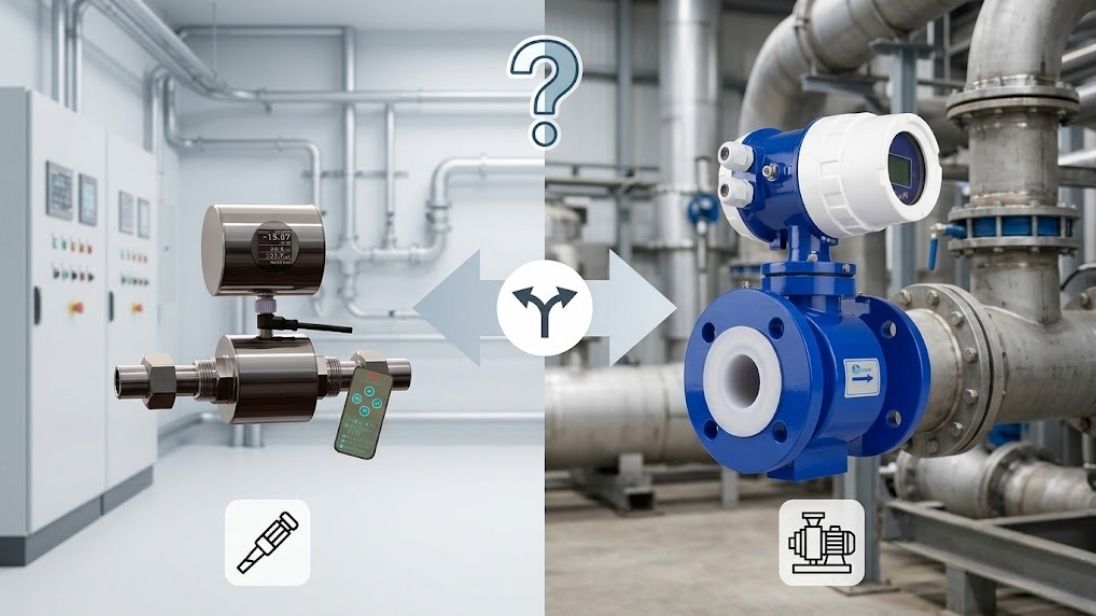
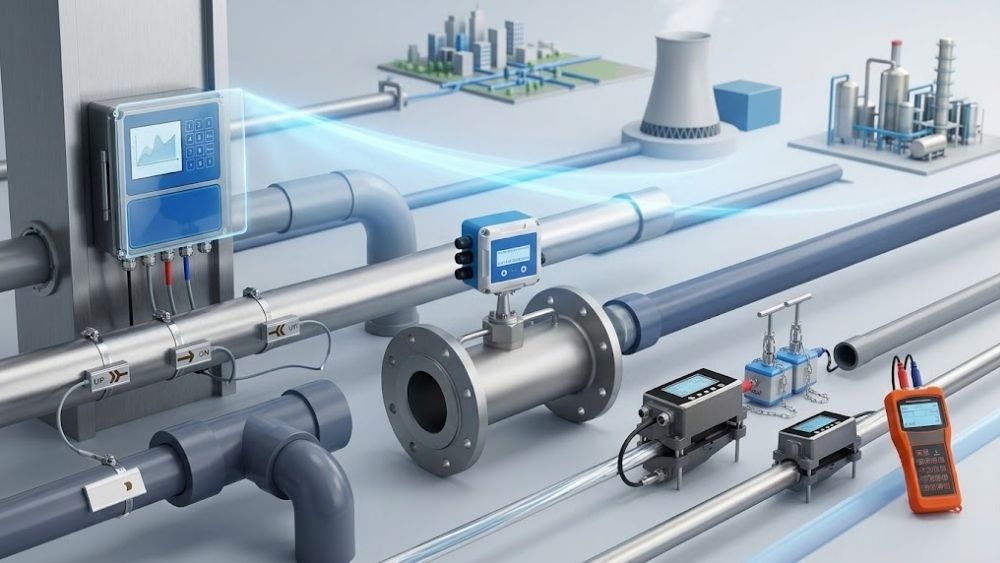
Clamp-on meters attach to existing pipes from the outside. You don’t need to cut into the pipeline or halt your process. Installation takes about 30 minutes with one person. The non-invasive design prevents leaks and contamination risks. It offers flexibility for temporary measurements or system audits.
Inline meters integrate directly into the piping system and deliver higher accuracy because they measure across the entire pipe cross-section. Multiple sensor pairs can compensate for flow profile distortions. But installation requires pipeline shutdown, pipe cutting, and flange connections. New projects and applications that need superior long-term performance benefit most from inline configurations.
Pipe Characteristics That Affect Model Selection
Pipe material affects signal transmission. Stainless steel, copper, and carbon steel pipes work well with ultrasonic measurement. Pipes made of ductile iron or those with liners such as asbestos cement present considerable challenges. Wall thickness matters too. Thicker walls require higher-end meters.
Meters handle pipe diameters from 0.5 inches to 256 inches. Temperature also plays a role. Normal temperature ranges work fine, but applications above 250 degrees Fahrenheit need advanced models. The pipe must remain full of liquid for accurate volumetric flow calculation. Straight pipe runs of at least 10 diameters upstream and 5 diameters downstream ensure stable flow profiles.
Accuracy Standards for Different Industries
Accuracy requirements depend on your application. Simple flow verification may work fine with less advanced meters offering ±2% accuracy. Billing purposes, custody transfer, or batch process control need much tighter tolerances. High-end ultrasonic meters achieve ±0.5% accuracy. Industries like oil and gas with fiscal custody transfer applications must comply with specific standards such as AGA Report No. 9 or API Chapter 5, Section 8.
Selecting the Right Model for Your Specific Application
General Purpose Applications: FHS330 Clamp-On Ultrasonic Flow Meter
FHS330 handles most standard water measurement tasks for pipe sizes from DN25mm to DN5000mm. The wall-mount design delivers ±0.5% accuracy with 0.1% repeatability. Municipal water systems, HVAC chilled water loops and fire protection monitoring use typical installations where non-invasive installation prevents service interruption.
Heavy-Duty Industrial Environments: FHS300 High-End Model
Intel FPGA integrated circuits power the FHS300, which samples at 300 times per second compared to standard meters operating at 50 times or less. This high-speed processing tolerates continuous bubbles or impurities for up to 5 seconds. Chemical plants, power generation facilities and industrial cooling systems benefit from its improved signal processing in challenging fluid conditions.
Large Pipeline Systems: FHS300 Plug-In Solution
Insertion sensors work better than clamp-on transducers on pipes DN300 and larger. The plug-in configuration provides stronger ultrasonic signals and greater stability on very large diameter pipes [User Guidelines]. Water treatment plants and long-distance transmission mains get reliable measurement despite thick pipe walls.
Maximum Accuracy Requirements: FMU854 Pipe Section Type
Factory-calibrated pipe sections achieve ±0.5% accuracy for flowmeter applications. Dual-channel sensors integrate into flanged spool pieces suitable for custody transfer, energy management and laboratory testing systems. Installation needs pipeline shutdown but delivers superior repeatability for precision measurement.
Mobile Testing Needs: FHS320 Portable Ultrasonic Water Flow Meter
Battery operation provides 16 hours of continuous field measurement. The portable unit measures pipes from 1″ to 48″ with ±1% accuracy. Maintenance teams use FHS320 for pump performance verification, temporary monitoring and multi-point pipeline inspection without permanent installation.
Compact Systems: F600 for Small Diameter Pipes
F600 targets 8A, 10A, 15A, 20A, 25A and 32A pipes and deals with the signal transmission challenges on small diameters. Semiconductor cooling systems, laboratory equipment and precision circulation loops need this specialized configuration.
High Precision Measurement: FHS330 High Precision Version
Improved accuracy specifications suit energy management and high-value process measurement where measurement uncertainty has to stay minimal [User Guidelines]. Industrial utility monitoring and precision flow systems justify the performance upgrade over standard clamp-on models.
Fast Selection Guide: Find Your Model in 3 Steps
Quick Selection Table by Application Type
Three questions streamline your selection process. First, confirm your fluid type: clean water suits transit-time meters, while dirty liquid needs Doppler technology. Second, select mounting type based on whether downtime is acceptable. Third, verify pipe diameter, material and accuracy requirements.
| Customer Requirement | Recommended Model |
| No pipeline modification allowed | FHS330 / FHS300 |
| Large diameter pipes | FHS300 Plug-in |
| Highest accuracy needed | FMU854 / FHS330 High Precision |
| Temporary measurement | FHS320 |
| Small pipe size | F600.F700 |
Selection Flow Chart for Easy Decision Making
Pipeline modification capability determines your path. Clamp-on meters install without cutting pipes or halting processes. Installation takes under two minutes on existing configurations. Inline meters require shutdown and pipe section removal but deliver superior long-term stability.
At the Time Pipeline Shutdown is or isn’t Possible
Insertion meters and clamp-on designs allow installation without process shutdown. Hot-tap fittings enable insertion probe installation in 2-4 hours. Clamp-on ultrasonics mount externally in under an hour. Conversely, inline full-bore meters require process shutdown. Update projects, temporary flow verification and facilities where uninterrupted operation is critical benefit from clamp-on technology.
Model Selection Summary and Final Considerations
Complete Model Comparison Chart
Your meter choice balances installation flexibility against measurement precision. Clamp-on models avoid pipeline shutdown but inline configurations deliver superior long-term stability. FHS330 serves general applications, FHS300 handles industrial environments, FHS300 Plug-in addresses large diameters, FMU854 provides factory-adjusted accuracy, FHS320 makes portable inspection possible, and F600,F700 solves small-diameter challenges.
Total Cost of Ownership Factors
Purchase price represents only a fraction of true costs. Maintenance expenses, spare parts availability and labor all contribute by a lot to total ownership costs over the operational lifespan, along with how often you need to adjust the system. Ultrasonic meters require minimal routine maintenance because they contain no moving parts. Annual or biennial accuracy verification is typically enough, though frequency depends on measurement criticality and industry standards. Harsh environmental conditions accelerate wear and require more frequent inspections. Preventative maintenance schedules reduce long-term expenses by preventing major failures. Manufacturer support agreements provide scheduled maintenance and genuine spare parts access, along with adjustment services.
Getting Started with Your Selected Model
Installation planning starts with verifying straight pipe requirements. Most meters need 10-20 diameters upstream and 5-10 diameters downstream for accurate measurement. Plastic piping systems require earth ground connections for proper function.we support helps configure appropriate housing for your environmental conditions.
Conclusion
Selecting the right ultrasonic water flow meter might seem complex at first, but the decision tree we’ve outlined simplifies the process by a lot. Your installation constraints come first, then pipe characteristics and accuracy needs. The right choice delivers years of reliable measurement with minimal maintenance costs.
Assess your specific requirements against each model’s strengths. This investment pays dividends through reduced downtime and lower operating costs. You also get accurate flow data for your critical applications.