The right insertion flow meter for large-pipe applications can separate accurate data from expensive guesswork. Nearly 1 in 5 gallons of water is lost through leaks and bursts, along with metering inaccuracies. This reality leads many engineers to insertion-style technology that offers better flow visibility. Engineers often ask me how an insertion-type flow meter compares with an inline meter for large-diameter pipes.
Both insertion and inline meters measure flow, but their designs, installation requirements, accuracy, and costs differ substantially. I will compare an insertion magnetic flow meter with a full-bore mag meter, along with an insertion electromagnetic flow meter and a traditional inline meter. This guide covers installation and cost factors to help you select the right meter.
Insertion Flow Meter vs Inline: How They Differ
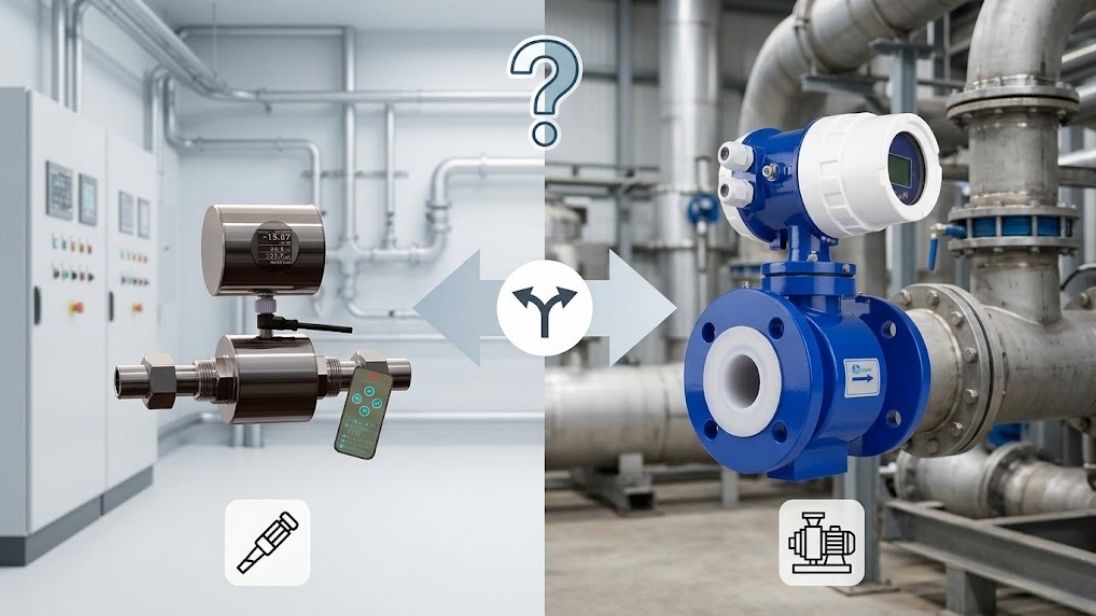
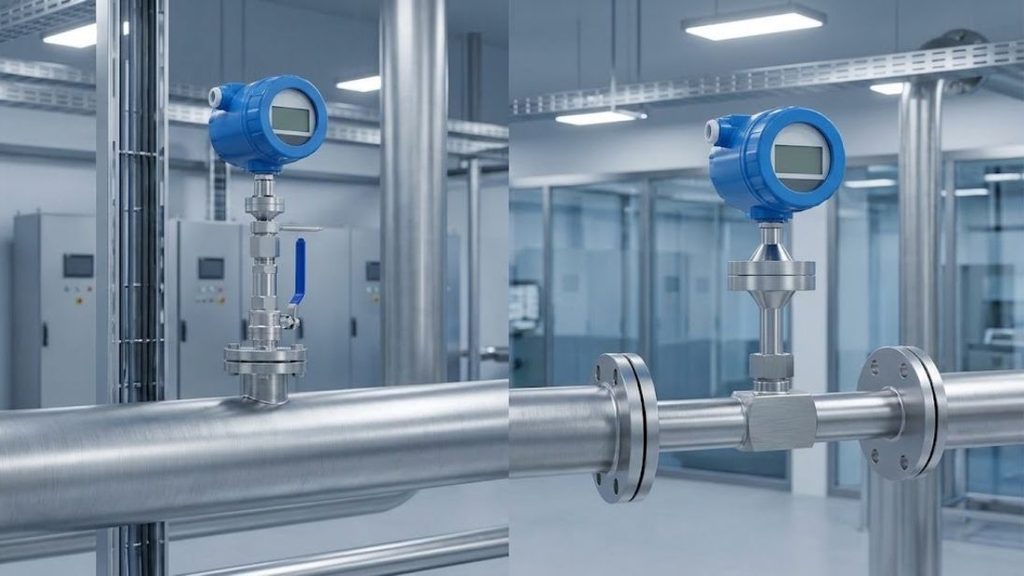
An insertion type flow meter uses a probe that passes through a hole in the pipe wall instead of becoming a permanent part of the pipeline. An inline meter works the other way because it becomes a physical section of the pipe. Each design fits into a piping system differently.
How an insertion type flow meter fits into an existing pipe
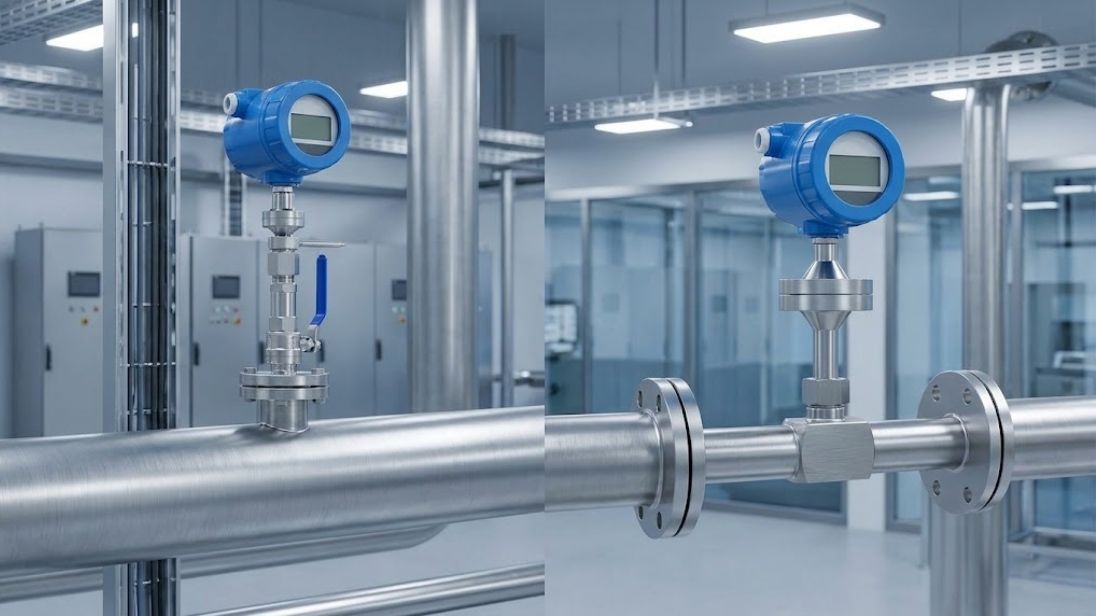
I install the probe through a hot-tap fitting, compression fitting, or valve assembly. This lets me access a pressurized line without draining it first. The sensing element sits in the flow stream, while the electronics and display remain outside the pipe. They may be mounted to a surface or supported by the rigid probe body.
This design makes insertion meters a practical option for pipes 1 inch and larger. Manufacturers offer full product lines in this format, including insertion magnetic models such as the PIT and PITe, plus insertion vortex models such as the DVE. Installation often requires only a weld-o-let or, at most, a flange connection. As a result, insertion meters cost far less than inline models once pipe diameter passes 6 inches.
I can also remove the probe to clean or calibrate it. Some designs include an extraction device that lets me remove the sensor without shutting down the system.
How an inline meter replaces a full pipe section
An inline meter’s flow body and measuring tube become part of the pipeline. The meter connects at the inlet and outlet through NPT threads, ANSI flanges, Tri-Clamp fittings, or weld connections. Fluid moves through a purpose-built measuring section, so the meter reads the full flow profile across the pipe’s cross-section rather than sampling only part of it. Inline meters therefore tend to provide more accurate readings than comparable insertion setups.
Installation requires more work. The pipe usually needs to be opened, and the process must be isolated before installing the spool piece. Inline thermal meters, to name just one example, cover pipe sizes from 1/4 inch through 4 inches with threaded or flanged ends. The company recommends an insertion-style meter when the line exceeds 4 inches.
Why meter design and sensing technology are separate choices
Insertion and inline describe a meter’s mechanical form, not its sensing technology. Magnetic, thermal, ultrasonic, and vortex sensing technologies are available in both configurations. We makes this distinction with its thermal mass meters. Notes that inline and insertion versions measure gas mass flow through the same thermal dispersion principle, while the installation method remains the main difference.
The FPI Mag extends this approach to magnetic flow measurement. Its insertion probe uses a multi-electrode array to capture the full flow profile. The design matches full-bore mag meter performance while retaining the hot-tap installation advantage.
How Installation Affects Accuracy in Large Pipes
Installation quality determines whether an insertion flow meter delivers reliable readings or noise disguised as data. Large pipe systems introduce added challenges, including probe placement and pressure handling, which I cover below.
Straight-run needs near pumps, valves, and bends
Insertion meters in pipes 6 inches and larger generally require 15D upstream and 7.5D downstream of straight pipe. Disturbances near the sensor, such as partially open valves that just need 25-50D upstream or out-of-plane double bends that require 23D, can increase reading errors to 50%. Pump discharge turbulence and cavitation add to the issue, so I keep meters well away from pump outlets.
Single-point probes vs multipoint flow measurement
A single-point insertion probe measures one part of the flow profile, so velocity distortion can affect it. Multi-path and multipoint designs, such as EPI’s MULTI series for large ducts, average readings across several sensing points and perform better where disturbances cannot be avoided.
Insertion depth and sensor alignment
I place the probe on the pipe centerline or at the mean axial velocity point, about 1/8 of the pipe diameter from the wall. Alignment within 2 degrees of the flow direction limits error to under 0.15%. A partial velocity traverse can then confirm that the profile is symmetrical.
Cases where flow conditioners can help
Vortab-style conditioners reduce the required straight run to as little as 7D. Captive Flow Conditioners for insertion meters require the probe exactly one pipe diameter downstream.
Full-pipe conditions and air pockets in liquid systems
The insertion sensor pipe must remain completely full. Air pockets can distort both electromagnetic and ultrasonic readings.
Pressure limits and safe access for meter removal
Lines above 5 bar require care during probe removal. Anything over 10 bar requires depressurizing the line first.
Compare Purchase, Installation, and Maintenance Costs
Budget conversations change once pipe diameter passes a certain threshold, and that is where insertion and inline meters begin to differ in price.
How pipe diameter affects meter price and shipping
Once a line reaches 6 inches or more, an inline meter typically costs more than an insertion unit of the same size because insertion designs avoid the larger flow body and measuring tube that increase material and freight costs. Original purchase prices for insertion meters remain lower for large pipe sizes in general.
Pipe work, lifting equipment, and shutdown costs
Insertion installations usually require only a weld-o-let or, at most, a flange connection. Inline meters require cutting into the line, which adds labor and material costs. A hot-tap assembly adds 10 to 20 percent to the insertion meter’s overall price, but it allows removal under pressure if I leave 2 to 3 feet of clearance. Inline removal, in contrast, usually requires a shutdown and drainage or isolation of that pipe section unless the system includes a bypass. Hot-tapping on larger inline jobs can increase the cost by one or two times., while shutdown coordination among instrumentation, mechanical, and operations teams can add another cost.
Cleaning, calibration checks, and long-term service costs
Both configurations perform well over time and have no moving parts.
Which Meter Fits Your Large Pipe Application?
Matching the meter to the application depends on the fluid type, pipe size, and acceptable downtime.
Conductive water and wastewater: insertion magnetic flow meter vs full-bore mag meter
Conductive-liquid applications can use an insertion magnetic flow meter such as the FPI Mag, which delivers accuracy close to full-bore accuracy at ±0.5%. The single-point SPI Mag maintains ±2% accuracy, and its price does not depend on line size. I prefer the FPI Mag in upstream treatment and the SPI Mag in downstream wastewater because the SPI’s flush sensors release debris more effectively. Aquaprobe-style insertion units support lines from 200 mm to 8,000 mm, offer ±2% accuracy, and allow hot-tap installation.
Gas lines: insertion vs inline thermal mass meters
Inline thermal mass meters suit DN15 to DN80 gas lines. Single-point insertion models work through DN300, while multi-point insertion models handle larger lines. A full-bore inline unit at DN300 can cost 5 to 10 times the cost of an insertion probe.
Live-line modernization: at the time an approved hot-tap setup makes sense
Hot-tap insertion meters can be installed and removed under pressure. They are rated to 1,000 psi, although removal is limited to 400 psi. This method supports pipe diameters from 4 to 138 inches.
New installations and strict accuracy targets: choosing an in-line meter
Full-bore inline meters achieve ±0.2% to ±0.5% accuracy. They are the preferred option if the line can be opened and precision is the main priority.
Conclusion
Insertion and inline meters each have their place, and the right choice depends on the pipe and fluid, as well as tolerable downtime. Larger pipes often make insertion meters easier and less expensive to install, while inline units provide greater accuracy when precision matters most. After I consider straight-run requirements and pressure limits, along with long-term maintenance, the decision becomes clear: I match the meter’s strengths to my application’s actual needs, not just its price tag.