Flow meter selection mistakes are common. 70% of installed flowmeters are either the wrong technology or the wrong size for their application. These errors lead to inaccurate measurements and process inefficiencies. Downtime can get pricey and turn profits into losses.
But there’s a better approach. Work together with sales engineers and you’ll get the right flow meter from the start. This piece will walk you through preparing for conversations with sales engineers. You’ll understand critical flow meter selection factors and criteria. You’ll make confident decisions that optimize your operations.
Why Flow Meter Selection Goes Wrong (And How Sales Engineers Help)
Common Selection Mistakes Engineers Make
The lack of qualified instrumentation engineers stands as one of the biggest problems across the industry. This shortage contributes to recurring selection errors that compromise measurement accuracy and push up installed costs.
Price-based flow meter selection often results in the highest installed cost. Organizations that make decisions using legacy information rather than current process data overlook critical flow meter selection factors that affect performance. Exaggerated range claims create false expectations. A meter advertised to measure velocities from 1 to 100 ft/s rarely provides accurate readings across that entire span. A meter sized for 0 to 30 Mgd delivers true accuracy only from 3 to 30 Mgd.
Oversizing ranks among the most frequent errors. Engineers often size equipment for 20-year growth periods, which causes problems at the time current flows run far below design rates. Many flowmeters suffer in performance as flows decrease toward the lower end of their viable range. The result is poor accuracy at actual operating conditions.
Fluid characteristics get overlooked during specification. An electromagnetic flow meter used for non-conductive fluids like oil produces no reading whatsoever. Turbine meters fail faster in slurry pipelines. Temperature and pressure compatibility matters just as much. A plastic-bodied meter installed in high-temperature steam lines leads to deformation and failure.
Installation conditions receive insufficient attention. A flow meter placed too close to pumps or valves causes turbulence that distorts measurements. Most velocity-based meters require specific straight run lengths, yet engineers attempt to force meters into constrained sites where adequate straight pipe doesn’t exist. This single oversight can introduce measurement errors up to 50 percent.
Confusion between accuracy and repeatability compounds these problems. Good repeatability does not guarantee accuracy. Instruments that are wrong but repeatable can be adjusted. Inconsistent readings cannot be fixed through calibration.
The Role of Sales Engineers in Successful Projects
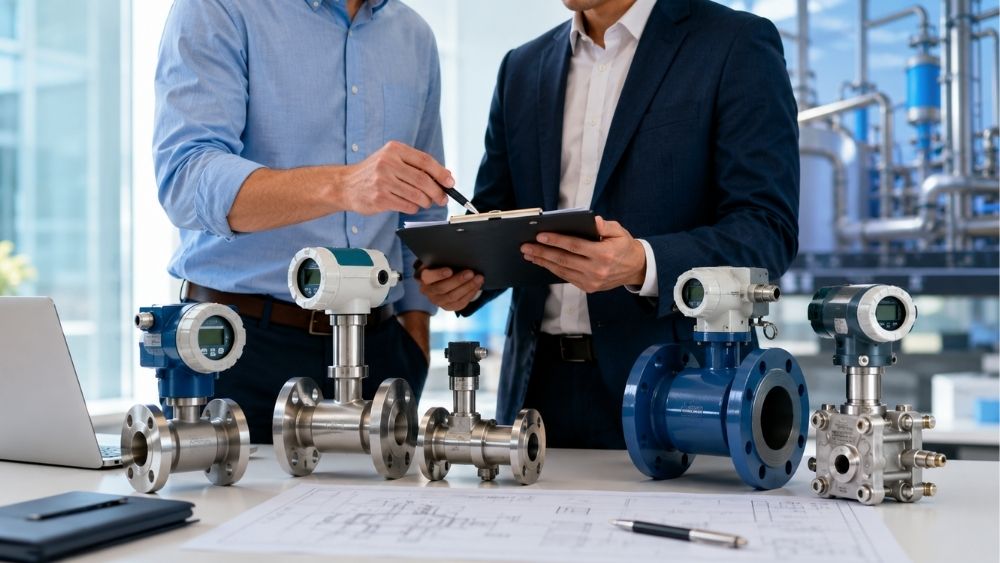
Consulting with knowledgeable instrumentation suppliers before purchase prevents costly mistakes. Sales engineers bring specialized expertise that fills the gap left by the shortage of qualified in-house instrumentation staff.
Leading flowmeter vendors offer application engineering services to guide proper selection. These professionals work through flow meter selection criteria rather than defaulting to familiar products. They ask targeted questions about fluid properties, conductivity, viscosity, temperature and corrosiveness before recommending meter types.
Sales engineers provide manufacturer-supplied sizing and selection tools that eliminate guesswork. They help engineers estimate flow envelopes using standardized tables and evaluate how proposed flowmeters perform across expected operating ranges. Sales engineers clarify the differences between accuracy statements and repeatability claims at the time specifications seem unclear, ensuring you understand true measurement capabilities.
Sales engineers identify installation constraints early. They determine straight pipe availability, assess vibration effects and recommend solutions such as pipe reducers to optimize velocity. This guidance transforms installation obstacles into workable solutions rather than post-installation surprises.
How Early Collaboration Saves Time and Money
Bringing sales engineers into projects during early planning stages yields measurable benefits. Early collaboration leads to breakthroughs, time and cost savings, reduced errors and elimination of unnecessary rework. Teams that identify and resolve issues before construction starts reduce schedule delays and cost overruns.
A well-integrated team improves project performance and reduces risks for everyone involved. Sales engineers who understand your complete process requirements can recommend meters matched to specific applications rather than sacrificing features to save costs. This approach thinks about total installed cost, including infrastructure requirements such as straight pipe runs that could cost more than the meter itself.
Early contractor involvement allows teams to lean into collective expertise and knowledge, resulting in true breakthroughs. Collaborative discussions about maintenance access, calibration requirements and system integration prevent misunderstandings that lead to change orders later. Projects stay on budget while delivering measurement systems that perform correctly from commissioning forward.
Preparing for Your First Conversation with a Sales Engineer
Successful collaboration begins with full preparation. Gathering complete information about your application before contacting a sales engineer prevents multiple callbacks and accelerates the selection process.
Understanding Your Process Requirements
Start by defining where the meter fits within your overall process. Involve plant operators during design to discuss maintenance access, calibration schedules and operational constraints. These conversations reveal practical considerations that specifications alone cannot capture.
Determine whether flow information needs totalization or continuous recording. Identify if data must transmit to SCADA systems or become available through web interfaces. Knowing who will use the meter and how they will interact with it shapes technology choices. To cite an instance, remote installations may require battery-powered devices, while process control applications demand up-to-the-minute analog outputs.
Establish what information requires monitoring and recording. Some applications just need event notifications such as high flow or zero flow alarms. While 4 to 20 milliamp outputs remain most common, facilities increasingly need MODBUS cards or other communication protocols to integrate systems.
Gathering Media and Fluid Characteristics
Media properties drive technology selection more than any other factor. Document these characteristics:
- Fluid type: Gas, liquid, suspension, or vapor
- Chemical composition: Complete formula and any hazardous components
- Density and viscosity: Liquids at operating temperature; gasses at 1 bar and 20°C
- Temperature range: Minimum, normal and maximum values
- Pressure conditions: Operating pressure and any pressure drop constraints
- Electrical conductivity: Electromagnetic flowmeters require conductivity above 20 microSiemens/meter
- Solids content: Particle size, abrasiveness and concentration
- Corrosivity and acidity: pH levels and material compatibility concerns
- Flow direction: Especially relevant when you have disk and piston flowmeters
Existing facilities should have this data readily available to review. New facilities can apply standard engineering criteria. Clean fluids allow different meter choices than those containing sand, stringy materials or abrasive particles.
Documenting Installation Site Conditions
Installation environment affects meter performance and longevity. Record whether the meter will be placed indoors, outdoors or in laboratory settings. Outdoor locations require weatherproofing and may need freeze protection.
Measure available space to install. Some flowmeters require substantial upstream and downstream straight pipe sections to provide accurate readings. Identify existing pipe bends, valves, tees and reducers near the proposed installation point. Document nominal pipeline width, pipe material, schedule and flange pressure ratings.
Note whether vibration or magnetic fields exist at the installation location. Verify if electrical or pneumatic power is available. Check if the area carries explosion hazard classifications requiring IECEx certification or FDA hygienic approvals.
Defining Accuracy and Performance Needs
Accuracy requirements depend entirely on application purpose. Flow measurement to bill demands extreme precision, while general process tracking tolerates looser specifications. Chemical feed control needs tighter accuracy than simple monitoring applications.
Think about whether absolute accuracy or repeatability matters more to your process. Consistent repeatability allows calibration adjustments even if absolute accuracy varies in some cases.
Document your budget to cover both purchase price and lifecycle costs, including installation, operation and maintenance. Establish required flow velocity ranges and confirm whether low pressure drop is necessary, defined as the difference between inlet and outlet pressure. These specifications give sales engineers the foundation they need to recommend appropriate solutions.
Key Flow Meter Selection Criteria to Discuss
After you gather preliminary information, your conversation with the sales engineer centers on four technical criteria that determine meter suitability. These discussions translate your application data into specific meter requirements.
Flow Rate Range and Turndown Requirements
Turndown ratio defines the range between maximum and minimum flow rates a meter can accurately measure. You calculate it as maximum flow divided by minimum flow. A flow meter with a maximum capacity of 100 liters per minute that can accurately measure down to 10 liters per minute has a 10:1 turndown ratio.
This specification matters because industrial processes rarely operate at constant flow rates. A meter with a 10:1 turndown ratio and a maximum flow capacity of 100 GPM can accurately measure down to 10 GPM. Accuracy falls outside acceptable limits below that threshold. Different technologies offer dramatically different capabilities. Thermal mass flow meters provide 1000:1 turndown, while orifice plate meters manage only 3:1. Turbine meters deliver 10:1 typically. Magnetic flowmeters range from 20:1 to 100:1, and multipath ultrasonic meters often achieve 50:1.
Pipe Size, Material, and Straight Run Availability
Pipe configuration directly affects measurement accuracy. Line sizes up to 6 inches require 20 pipe diameters upstream and 10 pipe diameters downstream from the metering point for fully developed flow profile. Lines over 6 inches just need 15 diameters upstream and 7.5 diameters downstream. You can locate a 7.5-foot straight run of 3-inch pipe realistically, but finding an appropriate 22.5-foot run for 12-inch pipe becomes more difficult.
Electromagnetic flow meters require minimum 5 straight pipe diameters upstream and 2 downstream. Vortex flow meters just need longer runs, 35 diameters upstream and 5 downstream typically. Pipe bends, valves, tees, and reducers can create measurement errors up to 50 percent for certain meters. The pipe must be full for accurate measurement in most cases, and you should avoid downward flow when measuring liquid.
Temperature, Pressure, and Environmental Factors
Flow meters must withstand physical and chemical conditions of the process environment. Confirm maximum allowable operating temperature and pressure before final selection. Also verify wetted material compatibility with process fluid and resistance to corrosion, abrasion, or scaling. Temperature directly influences fluid density and volume and affects measurement accuracy. High pressure increases gas density and affects volumetric flow readings, while extreme pressure drops can cause cavitation that damages both meter and process line.
Output Signals and Integration Requirements
The selected flow meter should support output formats compatible with existing control systems. Common signal options include 4-20 mA analog output, pulse or frequency output, and digital communication protocols such as Modbus or HART. The 4-20 mA current loop remains the industry standard for analog signal transmission because of its noise immunity and knowing how to carry both signal and power over long distances. Pulse outputs provide digital signals where frequency corresponds to flow rate. This makes them ideal for batching and totalization applications.
Navigating the Flow Meter Selection Guide Together
When you work through selection guides with your sales engineer, raw data transforms into applicable recommendations. This shared review eliminates unsuitable technologies and identifies optimal solutions.
Reviewing Flow Meter Selection Factors
Sales engineers use your application data to assess which technologies remain viable. The first step involves identifying whether the fluid is liquid, gas, or steam. This determines which measurement principles apply. Electromagnetic and ultrasonic flow meters emerge as main candidates for clean or conductive liquids such as water and chemical solutions. Slurries containing suspended solids require meters without moving parts or internal obstructions. Gas flow measurement introduces challenges. Compressibility and temperature dependency point toward vortex and differential pressure technologies.
Understanding the Flow Meter Selection Table
Flow meter selection charts provide visual guidance. They map process conditions against meter technologies. These tables display which meters work best for conductive liquids, non-conductive fluids, high solids content, pulsating flow, and high viscosity. The chart functions as a quick reference that your sales engineer interprets based on your specific parameters.
Matching Technology to Your Application
Propeller meters measure fluids containing sand, dirt, iron and other contaminants. This makes them suitable for drinking water systems and well water withdrawal. These meters fail in raw wastewater containing stringy materials and wipes. Electromagnetic meters handle conductive materials like water and wastewater with no moving parts that corrode. Mag meters will not function for non-conductive fluids. You need ultrasonic or other technologies.
Assessing Material Compatibility and Certifications
Wetted materials must resist chemical attack from process fluids. Liner choices include PFA and PTFE fluoropolymers for broad chemical resistance. Some utilities require NSF-61, NSF-372 approvals or ISO 9001 certification. Manufacturers may accredit calibration laboratories through NVLAP, which provides NIST accreditation using ISO/IEC 17025:2005 requirements.
Making the Final Selection Decision
Comparing Total Cost of Ownership
Hardware cost represents just one component of total ownership expenses. Evaluate offers by including installation complexity, integration with control systems, calibration frequency, and internal time managing the system. Request quotes based on similar measurement points, accuracy specifications, pipe sizes, and communication protocols. Each quote should have mounting kits, cables, calibration reports, and power supplies.
Maintenance and calibration conditions vary substantially between technologies. Some suppliers offer cartridge swap programs with minimal downtime. Lower maintenance costs can outweigh higher purchase prices over ten years.
Reviewing Installation and Maintenance Requirements
Proper installation will give measurement accuracy from startup. The flow sensor, transmitter, and associated wiring must meet manufacturer specifications. System parameters need configuration before commissioning. Most industrial flow meters need cleaning every 3 to 6 months. Harsh conditions with contaminated fluids require more frequent attention.
Proving the Selection Right Against Your Specifications
Validation will give the system its stated functional intent. Verification confirms equipment operates according to manufacturer specifications. Perform zero calibration with the pipe empty, then full. Follow manufacturer instructions.
Planning for Commissioning and Support
Commissioning services have equipment configuration, loop checks, field troubleshooting, NIST-traceable calibration, and customer training. Confirm technical support availability through phone, email, or remote assistance platforms.
Conclusion
You now have a clear roadmap for selecting the right flow meter the first time. Success depends on full preparation and working together with knowledgeable sales engineers who bring specialized expertise to your project.
Complete information about your fluid properties, installation conditions and performance requirements should be gathered before you reach out. This groundwork reshapes technical discussions into practical recommendations that prevent pricey mistakes.
Note that 70% of flow meters are incorrectly specified, but you don’t have to become part of that statistic. Work with sales engineers, ask detailed questions and assess total ownership costs rather than purchase price alone. Your measurements will be accurate from day one.