The grounded vs ungrounded thermocouple decision can directly affect your system’s performance and reliability. Thermocouples are essential instruments that keep systems operating efficiently, especially when you have equipment like turbine systems and gas compressors. The wrong thermocouple junction types can lead to inaccurate readings or slow response times in critical applications.
The debate between grounded thermocouple and ungrounded thermocouple options isn’t straightforward. Grounded thermocouples react faster. This makes them ideal for high-pressure applications. Ungrounded thermocouples offer better electrical isolation and accuracy. Of course, there’s also the exposed vs grounded vs ungrounded thermocouple consideration for specific environments.
In this piece, we’ll help you determine which thermocouple junctions work best for your specific needs.
Understanding Thermocouple Junction Types
What is a thermocouple junction?
A thermocouple junction is the measuring point where two dissimilar metal wires are welded or fused together. This junction sits at the tip of the thermocouple probe. Temperature sensing occurs only at this specific location. The two metal wires, called the positive and negative legs, are the foundations of temperature measurement when joined at this point.
The junction is referred to often as the hot junction or measuring junction. These terms describe the same component: the welded tip where temperature detection happens. Junction design affects response time and durability.
How thermocouple junctions work
Thermocouples operate through the Seebeck effect, a physical phenomenon found in 1821. When two different metals join and experience a temperature difference, they generate a voltage proportional to that temperature difference. This voltage can be measured and converted into an accurate temperature reading.
The voltage isn’t generated at the hot junction alone but along the wire in regions where a thermal gradient exists. A thermocouple circuit contains at least two junctions: the measurement junction at the probe tip and a reference junction where thermocouple wires connect to measuring instruments. The output voltage relates to the temperature difference between these two junctions.
The three main junction types
Sheathed thermocouples come in three junction configurations: grounded, ungrounded, and exposed. Each design delivers specific advantages with corresponding trade-offs.
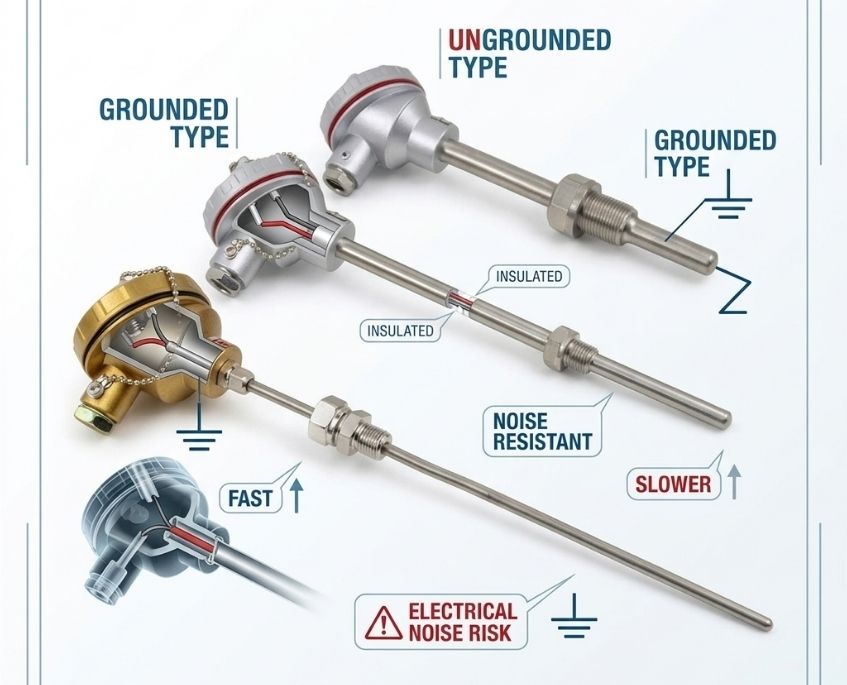
Grounded junctions have thermo-elements welded into the end cap using the same weld rod as the sheath material. Both thermocouple wires and sheath are welded together. This forms one junction at the probe tip. Direct metal-to-metal contact creates a shorter thermal route and enables fast time response. But grounded thermocouples are subject to EMF interference because the sheath contacts surrounding areas and provides a path for electrical noise.
Ungrounded junctions have thermo-elements welded together but electrically isolated from the sheath. The wires are separated by mineral insulation and suspended within the sheath without touching the edges. This configuration provides steady temperature readings at the cost of slower response time.
Exposed junctions position the welded thermo-elements outside the sheath. This design provides the fastest time response but exposes elements to contamination. It cannot be used in environments with high solids percentage, high pressure, or liquid material.
Grounded Thermocouple: Features and Performance
What makes a thermocouple grounded
A thermocouple becomes grounded when the junction is welded to the sheath at the sensor’s tip. This welding process creates a physical and electrical connection between the thermocouple wires and the protective metal sheath. The conductor alloy weld bead is positioned in contact with the sensor’s outer protective metal sheath.
Faster response time advantage
Grounding the junction improves response time by approximately 50 percent. A grounded junction reaches 63.2% of measured temperature in just 2.2 seconds when placed in still water at 80°C with a 0.250-inch sheath diameter. An ungrounded junction takes 4.1 seconds. A standard 6mm grounded probe achieves this same threshold in 0.6 seconds when water flows at 1 m/s.
Direct heat transfer benefits
The metal-to-metal contact creates a shorter thermal pathway compared to an ungrounded thermocouple. Heat travels from the process medium through the metal sheath and weld point to the sensor wire. The wire is part of the sheath, so there is zero thermal barrier between the protection tube and the sensor. This contact creates minimal thermal resistance and results in more precise measurements.
Susceptibility to electrical noise
Welding the junction to the sheath creates an electrical connection between the wires and the sheath. This makes grounded thermocouples susceptible to noise induced by ground loops. Stray electrical noise picked up from the sheath appears in the thermocouple signal. This noise can cause issues in reading the thermocouple output because the signal has low voltage.
Ground loop problems explained
A ground loop occurs when the sensor connects to earth ground at the measurement point and the wires connect to a controller grounded in another location. The two grounds may not be at the same voltage potential and create an undesired circuit that may damage equipment. This gets offset errors and erratic jumping readings, and can burn out the input channel.
Ungrounded Thermocouple: Features and Performance
How ungrounded junctions are constructed
The junction is not welded to the metal sheath in an ungrounded thermocouple. The welded bead sits isolated from the protective sheath and separated by high-purity mineral insulation. Non-conductive powder such as magnesium oxide surrounds the junction at the tip of the sensor. This material creates a buffer that slows thermal transfer from the measured media to the junction.
Sheath materials include stainless steel and Inconel, chosen for their durability. The mineral insulation prevents electrical contact while still allowing heat transfer to work.
Electrical isolation advantages
The thermocouple wire is electrically isolated from the metal sheath and case, so ungrounded thermocouples reduce the risk of ground loops. The junction remains detached from the probe wall and prevents electrical noise from interfering with the signal. Systems with multiple sensors or variable ground potentials benefit from this design because it prevents ground loops and reduces risk of faulty readings or equipment damage. The isolation breaks the galvanic path between the process and the controller.
Better accuracy for low-level signals
Electrical isolation yields greater temperature measurement accuracy, especially with low-level signals. The distance from the sheath plays a central role in giving ungrounded junction types better accuracy. Ungrounded thermocouples reduce signal distortion by maintaining electrical isolation between the junction and sheath.
Slower response time trade-off
Response times are 1.5x longer than grounded thermocouples typically. Multiply time constants by 1.5 for beaded-type and ungrounded junctions. Heat must travel through the metal sheath and magnesium oxide powder to the sensor wire.
Insulation resistance testing capability
Ungrounded thermocouples allow inspection of the insulation resistance between the outer sheath and the thermocouple circuit. Grounded thermocouples do not allow this inspection.
Choosing Between Grounded and Ungrounded Thermocouples
Grounded for high-pressure applications
Grounded thermocouples are recommended for high-pressure applications where you just need fast response. They work well to measure static or flowing corrosive gas and liquid temperatures. Grounded designs have been tested to withstand operating pressures up to 40,000 PSIg. Proof pressure testing was completed at 60,000 PSIg.
Ungrounded for corrosive environments with accuracy needs
Ungrounded thermocouples deliver better results when corrosive environments just need both shielding and accuracy. The electrical isolation provides protection in settings with electromagnetic noise, such as power electronics and inverters. Both grounded and ungrounded types handle corrosive conditions. Ungrounded variants prioritize measurement precision over speed.
Exposed junction as a third option
Exposed junctions offer the fastest response time but are limited to non-corrosive and non-pressurized applications. The junction protrudes beyond the sheath and becomes vulnerable to physical damage and contamination. This design suits laboratory settings or controlled environments where quick response outweighs durability concerns.
Testing if your thermocouple is grounded or ungrounded
Set a multimeter to ohms and perform a continuity test between a lead wire and the outer sheath tip. A grounded thermocouple shows fluctuating continuity readings with an audible beep. An ungrounded thermocouple displays no continuity and shows a “0” or “1” reading.
Conclusion
The choice between grounded and ungrounded thermocouples depends on your specific application needs. Grounded types deliver faster response times for high-pressure systems. Ungrounded variants provide superior electrical isolation and accuracy in noisy environments. Neither option is better across the board, and each excels in different scenarios.
Test your existing thermocouples with a multimeter before you make your decision. This will help you understand what you’re using now. A continuity test helps you determine whether upgrading or switching junction types will improve your system’s performance.