A surprising 62% of lubrication professionals rely on some type of viscometer for oil analysis. Understanding viscometers and their working principles matters greatly to anyone involved in fluid quality control in industries of all types.
Viscometers are scientific instruments that measure fluid viscosity by monitoring flow under controlled conditions. Several options exist at the time we discuss viscometer types, based on specific applications. Capillary viscometers, rotational viscometers, falling ball viscometers, and vibration viscometers represent the most common choices. These types operate on distinct principles but share a single purpose – they measure a fluid’s thickness or thinness accurately.
This complete guide will help you understand what viscometers are and how their different types work in practical applications. On top of that, we’ll get into viscosity measurement techniques and explain the distinction between kinematic viscosity (measured in centistokes) and absolute viscosity (measured in centipoise).
What is a Viscometer and Why It Matters
A viscometer plays a vital role in fluid analysis. Companies of all sizes, from pharmaceuticals to food processing, use these specialized devices. They give an explanation of material properties that affect production and end-use performance.
Viscometer definition and purpose
A viscometer measures a fluid’s viscosity—the internal resistance to flow or deformation under applied force. Unlike rheometers that measure variable viscosities under different flow conditions, viscometers measure constant viscosity at specific flow conditions. These devices calculate how “thick” or “thin” a fluid is by measuring its resistance to movement.
Viscometers determine a fluid’s flow characteristics through various mechanisms. The fluid stays still while an object moves through it, or an object remains fixed while the fluid flows past it. The drag created by this relative motion directly measures viscosity.
Different viscometer designs meet specific measurement needs. To name just one example, capillary viscometers measure the time a fluid takes to flow through a tube, while rotational viscometers work like a spinning stick in the fluid and measure resistance to rotation. Ball viscometers watch an object’s descent through the fluid, and vibration viscometers detect oscillation dampening in the test material.
Understanding viscosity in fluids
Viscosity shows how much a fluid resists flow. The measure tells us a substance’s resistance to motion under an applied force. Molecular friction within the fluid creates this resistance. Like friction affects moving solids, viscosity determines the energy needed to make a fluid flow.
The basic viscosity equation reads:
Viscosity = shear stress/shear rate
Shear stress represents the force per unit area needed to move one fluid layer relative to another. The shear rate measures the speed change at which intermediate layers move relative to each other. Scientists express the result in centipoise (cP), which equals 1 mPa·s (millipascal second).
Water flows faster than honey or oil because water has low viscosity. Honey and oil have higher viscosities. So high-viscosity fluids need more force to flow than low-viscosity ones.
Fluids split into two main categories based on their viscosity behavior:
Newtonian fluids: Keep constant viscosity whatever the applied shear rate (examples: water, honey)
Non-Newtonian fluids: Show varying viscosity based on shear rate (examples: toothpaste, cosmetic creams, mayonnaise)
Why viscosity measurement matters
Quality control teams across industries rely on viscosity measurement. Chemical processing plants use viscosity checks to learn about material processability and pumpability quickly. These checks also verify end product consistency. Toothpaste that becomes too runny creates usage problems. If it’s too thick, squeezing it from the tube becomes a challenge.
Accurate viscosity data helps businesses:
Develop and formulate products
Optimize manufacturing processes
Verify raw material quality
Meet final product specifications
Predict ground performance
Pharmaceutical and cosmetic companies need viscosity data to control drug delivery, stability, and application characteristics. Food producers ensure consistent texture and mouthfeel that customers expect. Oil companies consider viscosity the most important characteristic of base oil because it determines a lubricant’s effectiveness.
Technology advances brought solutions like the SPX504 Tuning Fork Inline Density Meter. This device monitors viscosity in real-time in industrial settings. Though mainly a density meter, it figures out viscosity based on liquid’s damping effect on a vibrating fork. Operators can detect viscosity changes without needing a separate viscometer. This technology works best especially when you have continuous monitoring needs where viscosity changes during processing.
Manufacturers use viscosity measurements to ensure product quality consistently. The right testing and measurement methods lead to reliable output that meets regulations and customer expectations. Viscosity ranks among the most tested properties in quality control across sectors. This makes viscometers essential tools in modern production facilities.
How Viscosity is Measured with a Viscometer

The physics behind fluid flow plays a vital role in measuring viscosity accurately. You need to learn both principles and practical applications that make these measurements reliable in industries to understand how a viscometer works.
Basic principle of viscosity measurement
The simple concept behind viscosity measurement involves measuring a fluid’s resistance to flow under applied force. Viscometers measure this resistance through various techniques based on one common principle—the relationship between shear stress and shear rate.
Viscosity measurement follows the two-plates model at its foundation. This model provides a mathematical framework to understand fluid behavior. Picture fluid placed between two parallel plates in a sandwich-like arrangement. The fluid moves as the top plate shifts while the bottom stays still. Two key conditions ensure accurate measurement: the fluid must stick well to the plates without slipping, and the flow must stay laminar.
Newton’s Law states that shear stress equals viscosity multiplied by shear rate. This means viscosity (shown by the Greek symbol η, eta) equals shear stress divided by shear rate:
η = τ/γ̇ [Pa·s] = [Pa/s]
This equation serves as the life-blood of viscosity measurement in viscometer types of all sizes. It’s worth mentioning that this simple relationship applies only to Newtonian liquids—fluids whose viscosity stays constant whatever the applied force.
Shear stress and flow rate explained
Shear stress shows the force per unit area needed to move one horizontal layer of fluid relative to another. This measures the tangential force required to slide adjacent fluid layers past each other. Molecules resist movement due to internal friction and create this stress when force applies to a fluid.
The velocity gradient between fluid layers, written as dv/dx, shows the speed change between intermediate layers—called the shear rate. Measured in reciprocal seconds (s⁻¹), shear rate describes how intensely the liquid shears during measurement.
To name just one example, see what happens when stirring honey versus water. Honey’s higher internal friction creates more resistance (higher shear stress) at the same stirring speed (shear rate) compared to water. Viscosity measures this resistance to deformation caused by inter-molecular friction.
Most viscometers work by controlling either shear stress or shear rate and measuring the result. Rotational viscometers measure torque (related to shear stress) needed to keep a spindle rotating at steady speed (fixed shear rate) in the fluid.
Units of viscosity: cP and cSt
Viscosity measurements come in two main forms: dynamic (absolute) viscosity and kinematic viscosity. The difference between these types helps select proper measurement methods and understand fluid behavior under various conditions.
Dynamic viscosity measures a fluid’s internal resistance to flow under applied force. The pascal-second (Pa·s) serves as its SI unit, though people have widely used poise (P) historically. Most fluids have viscosity nowhere near 1 Pa·s, so measurements often appear in millipascal-seconds (mPa·s) or centipoise (cP):
1 Pa·s = 10 poise (P) = 1000 mPa·s = 1000 cP
1 centipoise (cP) = 1 millipascal-second (mPa·s)
Water at 20°C has a viscosity of almost exactly 1 centipoise, which makes this unit quite practical.
Kinematic viscosity equals dynamic viscosity divided by fluid density. This measures a fluid’s resistance to flow under gravity and proves significant in petrochemical applications for fuels and lubricants. Square meters per second (m²/s) serves as its SI unit, though stokes (St) or centistokes (cSt) see more common use:
1 St = 100 cSt = 1 cm²/s = 10⁻⁴ m²/s
1 cSt = 1 mm²/s
Unit conversion works like this:
Kinematic viscosity (cSt) = Dynamic viscosity (cP) ÷ Density (g/cm³)
Dynamic viscosity (cP) = Kinematic viscosity (cSt) × Density (g/cm³)
These conversions help industrial settings compare or standardize measurements across different testing methods. Standardized units provide consistent, reliable data that various industries rely on to optimize processes and control quality.
Types of Viscometers Explained
Scientists and engineers have created clever ways to measure viscosity. Each method offers unique benefits for different uses. Let’s look at the main types of viscometers and what makes each one special in measuring fluid resistance.
Rotational viscometers
These devices measure viscosity by putting a spinning spindle into the test fluid. They measure the force needed to keep the spindle turning at steady speed. This measurement shows the fluid’s internal shear resistance. Rotational viscometers give absolute viscosity readings by measuring the fluid’s internal shear stress, unlike methods that depend on gravity.
You’ll find these instruments in several forms:
Coaxial cylinder viscometers: Have a bob that spins inside a fixed cup holding the sample
Cone and plate viscometers: Place a shallow cone right next to a flat plate with the sample between them
Rotating spindle viscometers: Most people use these because they work well and cost less
Different springs help measure various viscosity ranges. L-type springs work for thin liquids like solvents and oils. R-type springs suit medium-thick materials such as paints and adhesives. H-type springs handle thick substances like mayonnaise and pastes.
Capillary viscometers
U-tube viscometers, as many call them, rank among the most common tools for testing Newtonian fluids. These glass devices show how fast fluid moves through a thin tube using gravity or suction.
The device works by timing how long a specific amount of fluid takes to flow between two marks through a tiny tube. Multiplying this time by the viscometer’s calibration number gives the kinematic viscosity. Ostwald and Ubbelohde models lead the pack in popularity.
These tools need just a small sample and give precise results for thin to medium-thick Newtonian liquids. Clean equipment prevents contamination that could throw off measurements.
Falling ball viscometers
These tools find viscosity by timing a ball’s descent through the test fluid. They work based on Stokes’ law, which links terminal velocity to viscosity.
Most models tilt the tube at 80° from vertical (Hoeppler principle). They come with balls of different sizes to measure viscosities from 0.5 to 70,000 mPa·s. The viscosity calculation uses this formula:
η = 2r²(σ-ρ)g/9v
The variables are: r (ball radius), σ (ball density), ρ (fluid density), g (gravity), and v (terminal velocity).
Clear Newtonian fluids work best with these viscometers. They can achieve accuracy between 0.5% and 2.0% based on ball choice.
Vibration viscometers
These devices create shear waves in the fluid and measure how they fade. A steel cylinder sensor vibrates at its natural frequency. The device measures how much energy the fluid absorbs and links this to viscosity.
They work in three ways:
Measuring power needed to keep vibration steady
Timing how long oscillations take to stop
Checking frequency changes against phase angles
These tools shine in industrial settings because flow conditions, container size, and process changes affect them less. Modern versions like the SPX504 track viscosity changes immediately while measuring density and temperature.
Orifice and cup viscometers
These simple tools use a container with a hole and a catch basin. They measure viscosity by timing how long it takes fluid to drain through the hole.
Popular versions include Zahn cups, Ford cups, Redwood, Engler, and Saybolt viscometers. Results come in seconds rather than standard viscosity units, making them practical but less exact than other methods.
Paint and coating industries love these devices for quick checks. Though less precise due to uneven pressure and energy loss at the hole, they help with quality control when exact measurements aren’t crucial.
How Each Viscometer Type Works
Every viscometer has a unique mechanism that turns fluid resistance into measurable data. Let’s explore how these precision instruments measure viscosity.
How rotational viscometers measure torque
Rotational viscometers work by submerging a spindle in the test fluid. They measure the torque needed to keep a constant rotation speed. This method measures resistance directly and eliminates gravity dependence. The focus shifts to the fluid’s internal shear stress to calculate absolute viscosity.
The system uses a motor-driven spindle, a spring system, and optical sensors. The fluid’s resistance creates torque as the spindle rotates. This torque deflects an adjusted spring. Optical sensors detect this deflection and convert the mechanical movement into viscosity readings.
The math behind this follows a simple principle: torque results from three factors—rotational speed, spindle geometry, and sample viscosity. Manufacturers offer three main spring types based on viscosity ranges:
L-type springs suit low-viscosity samples like solvents and oils
R-type springs work with medium-viscosity materials like paints and adhesives
H-type springs handle high-viscosity substances like pastes and ointments
The Couette design stands as the most common setup. It uses two concentric cylinders with fluid in the space between them. The viscosity (η) calculation uses this formula:
η = (M)/(4πLω) × (1/r² – 1/R²)
M represents torque, L is cylinder length, ω shows angular velocity, and r and R are the inner and outer cylinder radii.
How capillary viscometers use gravity and time
Capillary viscometers, also known as U-tube viscometers, use gravity to push fluid through a precise glass tube. These devices measure kinematic viscosity by timing fluid flow between two marked points.
The Hagen-Poiseuille equation serves as the foundation for capillary viscometers. This equation connects flow rate to pressure difference, tube dimensions, and fluid viscosity. Gravity-driven flow simplifies the equation to:
ν = Kt
ν represents kinematic viscosity, K shows the viscometer constant (unique to each device), and t marks the flow time in seconds.
These devices work best with Newtonian fluids and come in two main types—Ostwald and Ubbelohde. Ubbelohde’s design features a suspended level that makes measurements free from total fluid volume influence, which leads to better accuracy.
How falling ball viscometers apply Stokes’ law
Falling ball viscometers calculate viscosity by watching an object drop through the test fluid. The measurement comes from timing a ball’s descent between two marked points.
Stokes’ law explains the math behind this technique. It describes the drag force on a sphere moving through viscous fluid. The viscosity (η) calculation at terminal velocity—when buoyancy and drag forces match gravitational force—uses:
η = 2r²(ρₛ-ρₗ)g/(9v)
r shows ball radius, ρₛ represents ball density, ρₗ indicates fluid density, g marks gravitational acceleration, and v is terminal velocity.
This method needs specific conditions for accuracy. The flow must stay laminar (Reynolds number below 1), and container size matters. These viscometers often use an inclined tube to slow the ball’s descent, which makes measurement easier.
How vibration viscometers detect damping
Vibration viscometers use a unique approach—they create waves in the test fluid and track how fast these oscillations fade. A solid stainless steel sensor element vibrates at resonant frequency. The fluid’s viscous properties dissipate energy, which the device measures precisely.
These tools work through various methods:
Power input measurement to maintain steady vibration amplitude
Analysis of oscillation decay time after excitation stops
Detection of frequency changes relative to phase angle
The SPX504 Tuning Fork viscometer showcases this technology. It works as a density meter but also detects viscosity through its vibrating fork’s damping effect. Operators can track viscosity changes instantly without extra equipment, which makes it perfect for continuous processing.
Vibration viscometers handle fluid level changes well and resist external vibrations. They typically run at 300 Hz frequencies, which limits shear rate’s effect on viscosity measurements.
Kinematic vs Absolute Viscosity
Fluid behavior analysis relies on two fundamental concepts that often confuse people: kinematic and absolute viscosity. These measurements serve different purposes and represent distinct fluid properties in a variety of industries.
What is kinematic viscosity?
Kinematic viscosity measures a fluid’s internal resistance to flow under gravitational forces, without any external force except gravity. This property represents the ratio of absolute viscosity to the fluid’s density. The measurement shows how fast a fluid moves under a specific force.
Scientists compare this property to thermal and mass diffusivities as it represents the diffusivity of momentum. The SI units express kinematic viscosity in square meters per second (m²/s), though centistokes (cSt) remains more common in practice:
1 stoke (St) = 10⁻⁴ m²/s = 1 cm²/s
1 centistoke (cSt) = 10⁻⁶ m²/s = 1 mm²/s
Water’s kinematic viscosity measures about 1 cSt at 20°C.
What is absolute viscosity?
Absolute viscosity (also called dynamic viscosity) measures a fluid’s resistance to flow under an external and controlled force. This measurement quantifies the internal friction between fluid molecules that creates drag.
The relationship between shear stress and shear rate defines absolute viscosity:
μ = τ/γ
Pascal-second (Pa·s) serves as the SI unit, though industry professionals prefer centipoise (cP):
1 Pa·s = 10 poise (P) = 1000 mPa·s = 1000 cP
1 centipoise (cP) = 0.01 poise = 0.001 Pa·s
Water at 20.2°C possesses an absolute viscosity of precisely 1 centipoise, which provides a useful reference point.
How to convert between cSt and cP
Fluid density determines the relationship between these measurements. Simple formulas help convert between units:
Kinematic viscosity (cSt) = Absolute viscosity (cP) ÷ Density (g/cm³)
Absolute viscosity (cP) = Kinematic viscosity (cSt) × Density (g/cm³)
Dynamic viscosity shows higher numbers than kinematic viscosity for fluids with density greater than one. Honey demonstrates this principle at 68°F with its density of 1.42 g/ml and dynamic viscosity of 10,000 cP, resulting in a kinematic viscosity of 7,042 cSt.
Factors That Affect Viscosity Readings
Getting accurate viscosity measurements takes more than the right instrument—you just need to watch several variables that can substantially affect your readings. The best viscometer will give unreliable results without proper control of these vital factors.
Temperature control and its effects
Temperature is the most significant factor that affects viscosity measurement accuracy. A small temperature change can dramatically alter viscosity readings for petroleum products. You must control standard test temperatures (typically 40°C and 100°C) within ±0.02°C—a very strict requirement.
Paint viscosity can drop up to 6% with just a 1°C temperature rise, so precise temperature control becomes vital for quality testing. The bath temperature must stay uniform because your viscometer needs consistent temperature throughout. The type of circulator, age of bath fluid, and viscosity will affect temperature uniformity.
Sample handling and air bubbles
Your sample preparation directly affects measurement reliability. Shaking or stirring samples before measurement can create undefined shear load and skew your results. Samples with sediment are different—they need consistent mixing methods.
Air bubbles can cause big problems by making readings show false non-Newtonian behavior. You might need vacuum treatment to remove stubborn bubbles in severe cases. Of course, putting spindles into samples slowly helps prevent extra air from getting in.
Calibration and equipment cleanliness
Yearly calibration will give accurate and repeatable measurements while preventing SOP violations. A complete calibration process has full inspection, standards checks, pressure calibrations, viscosity calibrations, and cleaning.
Your viscometer must stay clean for precise measurements. But watch out for glass cleaners with high pH—alkaline cleaning solutions can change viscometer calibration by up to 20% over time. Make sure the viscometer is completely dry before adding another sample.
Viscometer size and timing accuracy
The right spindle size makes a big difference in measurement accuracy. Each size works best for specific viscosity ranges, so pick one that gives smooth readings at moderate speeds. Timing accuracy becomes critical with rotational viscometers. The fluid should take at least 200 seconds to pass between marked points for capillary viscometer measurements.
Your timing device should be accurate within ±0.07% of the reading and should measure with precision of one part in 2,000 or 0.1 second for a 200-second flow time. You should verify against accepted timing references yearly to keep this precision.
Inline and Online Viscometers: Real-Time Monitoring
Modern manufacturing environments now depend on continuous monitoring to maintain product quality and process efficiency. Inline viscometers have revolutionized traditional laboratory testing methods. These devices give us up-to-the-minute data analysis straight from the production line.
What are inline viscometers?
The process stream contains inline viscometers that measure viscosity continuously under operating conditions. We need to understand the difference between “inline” and “online” installations. “Inline” means all liquid flows through the viscometer, while “online” refers to installation in a bypass where the device measures only a portion of the fluid.
Manual sampling becomes unnecessary with these instruments, which reduces production process disruptions. Industries of all types use automated in-line viscosity monitoring as a vital way to ensure critical characteristics meet requirements across multiple batches.
How SPX504 uses tuning fork technology
The SPX504 Liquid Density Meter shows how advanced tuning fork technology enables up-to-the-minute measurements. We designed this device as a density meter, but it also detects viscosity through its tuning fork mechanism.
The measurement works in a beautifully simple way. The tuning fork vibrates at its natural frequency when submerged in fluid. The natural oscillation’s decay time (damping) directly measures the fluid’s viscosity. The fork receives magnetic excitation to create forced oscillation, then oscillates at its natural frequency. Microcontroller-based electronics calculate both the natural frequency and damping factor.
This technology delivers impressive specifications:
Temperature range: -20°C to +150°C
Pressure tolerance: Up to 20 MPa (with special versions reaching 20 MPa)
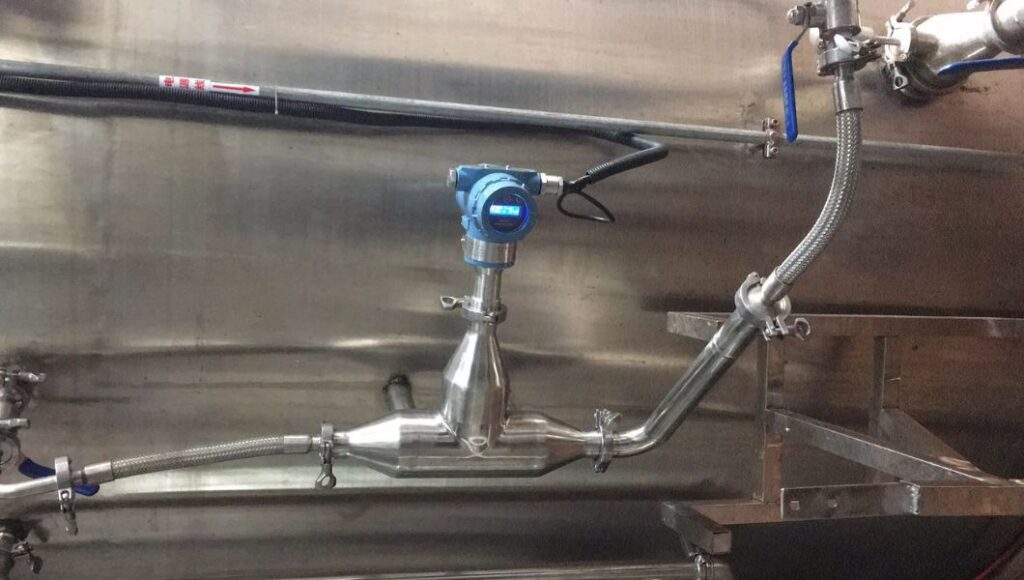
Sentec SPX504C Online Viscometer
The Sentec SPX504C is an integrated inline viscometer that operates based on vibration principles. A conical sensor vibrates freely at its resonant frequency, and the amplitude of vibration—proportional to fluid viscosity—is detected via voltage. This signal is calibrated to provide accurate viscosity readings. Built-in temperature compensation eliminates thermal drift, ensuring stable long-term performance in varying process conditions.
🔗 Learn more: https://cdsentec.com/product/online-viscometer/
Benefits of real-time viscosity control
Inline viscosity measurement with proper implementation offers major advantages in manufacturing operations. The automatic control of process fluid viscosity creates consistent product quality, reduces hold times, and eliminates human errors and expensive sample testing.
Many facilities relied on time-consuming laboratory testing until now. Inline monitoring offers clear advantages over traditional methods:
You can detect deviations from setpoints immediately and maintain consistent process control
The process stops at precisely defined endpoints, which reduces overprocessing
Downtime from waiting for lab results becomes minimal
Manufacturers can boost throughput, cut costs by eliminating routine sampling, and maintain stricter quality control. The systems capture temperature data at the exact point of viscosity measurement and provide evidence-based process intelligence that improves production efficiency.
Applications of Viscometers Across Industries
Viscometers are vital quality control tools that many industries use in their own unique ways to maintain product quality and performance.
Oil and lubrication testing
The petroleum industry relies heavily on viscometers to measure drilling fluids, well fluids, and crude oil’s viscosity. These measurements help support smooth extraction and processing. Viscosity stands out as the most important property of lubricants. It controls how they pump, affects their atomization, and determines their ability to protect engine parts.
Refineries now use automated viscosity measurements to make their processes better, from vacuum distillation to lubricant blending. Two prominent tools lead the industry – the Anton Paar SVM 3000 Stabinger Viscometer and PCS Instruments Ultra Shear Viscometer. They measure dynamic viscosity at different temperatures and shear rates up to 10^7 1/s.
Food and beverage processing
Food scientists know that viscosity shapes a product’s texture, mouthfeel, and flow during filling or dispensing. This quality control factor makes a big difference in process design and affects how products are stirred, mixed, pumped, and packaged.
The chocolate industry depends heavily on viscosity testing. Getting the right texture and flow can be tricky to produce and keep stable. Bakers face similar challenges – viscosity affects how ingredients mix or separate. A cake batter’s low viscosity can make ingredients separate at the wrong time, leaving you with a poor-quality cake.
Pharmaceutical and cosmetics formulation
Drug manufacturers need to control viscosity to manage drug delivery, stability, and how medicines work. Liquid medicines like suspensions, emulsions, and dispersions need the right viscosity to keep drug strength consistent throughout production.
The cosmetics industry finds that viscosity affects both product stability and user satisfaction. It determines how creams spread, how lotions feel, and how products come out of their containers. Toothpaste shows this perfectly – it needs to flow easily when squeezed but keep its shape afterward.
Paints, coatings, and adhesives
Viscosity affects how paints and coatings spray, level out, and stick to surfaces by a lot. AMETEK Brookfield’s KU-3 Viscometer leads the industry in measuring paint viscosity. It shows readings in Krebs units, grams, and centipoise, following ASTM D562 standards.
Poor flow can lead to streaks, patchy coverage, or paint that sags down surfaces. Getting viscosity right helps control drying time and finish quality, especially in high-volume automated painting. Krebs Stormer viscometers help measure architectural paints at medium shear rates (10-100 s⁻¹), which matches how paint flows from brushes or rollers.
Conclusion
Anyone working with fluid quality control needs to know how viscometers work and what they do. This piece covers different types of viscometers – from rotational and capillary to falling ball and vibration instruments. Each type measures fluid resistance in its own way. The difference between kinematic viscosity (measured in centistokes) and absolute viscosity (measured in centipoise) helps professionals pick the right measurement technique they need.
Viscosity measurement is crucial in many industries. Viscometers give data that affects product quality and performance, from keeping machinery well-lubricated to getting food consistency just right. The reliability of measurements depends on several factors. Temperature control, sample handling, equipment calibration, and timing accuracy need careful attention during testing.
Precise viscosity measurement is key to product consistency and process optimization in oil analysis, food processing, pharmaceutical formulation, and paint manufacturing. Viscosity affects how easily fluids flow through production equipment and how the final product works in ground applications.
Viscometers come in many designs for different uses, but they all do one thing – they provide reliable data about how fluids resist flow. This knowledge enables manufacturers to keep tight quality control, maintain consistent production, and create products that meet both regulations and what consumers want.
If you’re looking for a reliable solution for real-time viscosity monitoring, the SPX504/SPX504C inline viscometers are designed to meet the demands of precise, continuous measurement in complex industrial environments. Whether your application involves oils, coatings, chemicals, or food-grade fluids, we can help tailor the right configuration for your process.
👉 Tell us about your application requirements—fluid type, temperature, viscosity range, and installation environment—and our team will recommend the most suitable model and setup.