
If you’ve asked what pressure transmitter technology is and why it matters, know that these instruments keep industrial processes running smoothly and safely. A pressure transmitter connects to a transducer and converts pressure measurements into analog electrical signals that can be sent to control systems. These signals are typically 4-20mA current or 1-5 Volt voltage. Most pressure transmitters are durable and withstand harsh environments. Their service lives extend up to fifteen years. Anyone working with industrial pressure transmitters needs to understand the pressure transmitter working principle, how pressure transmitters work, and the role of components like the diaphragm pressure sensor. We’ll walk you through the defining characteristics, key components, pressure sensor operating principle, and various types of these critical instruments.
What is a pressure transmitter and how does it differ from a transducer
Defining the pressure transmitter
Pressure transmitters are electromechanical devices that measure pressure with high accuracy. The terms pressure sensor, pressure transmitter, and pressure transducer are used interchangeably in practice, though subtle differences exist between them. A pressure transmitter is a mechanical device that measures the expansive force of a liquid or gaseous sample. The sensing surface, made of steel or silicon, responds to applied pressure while electronic components behind it convert this force into an electrical signal.
The confusion around terminology stems from how these instruments evolved. We see both terms used to describe similar devices in practice, but understanding the difference helps when you specify equipment for your application.
Pressure transmitter vs pressure transducer
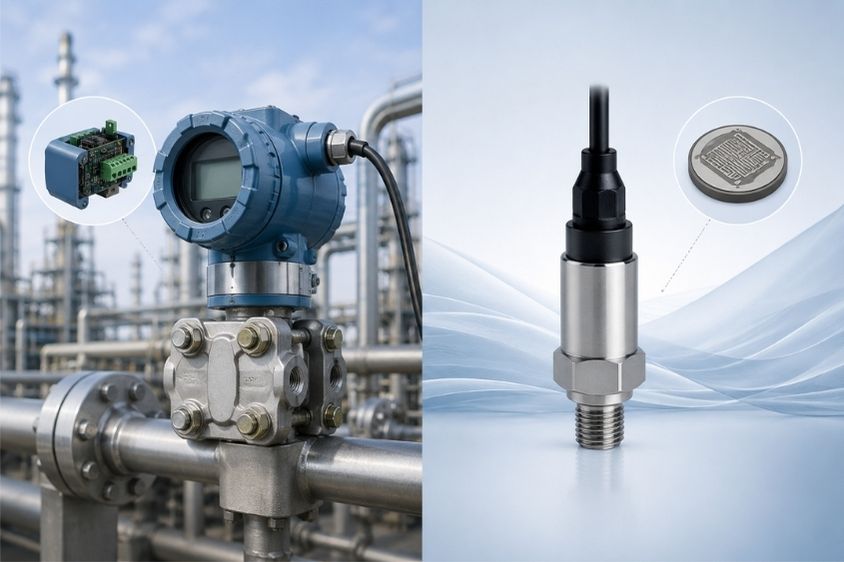
The main difference comes down to signal output and conditioning. A pressure transducer converts pressure into an analog electronic output signal as a millivolt per volt output, without linearization or temperature compensation. These signals work best within twenty feet of electronics.
Pressure transmitters build on transducer functionality. They add circuitry that linearizes, compensates, and amplifies the raw signal. A transducer sends signals in volts or millivolts. A transmitter sends signals in milliamps. The most common transmitter output is 4-20mA, though 0-5V and 0-10V are also used.
Transmitters dominate in large-scale processing industries like chemical production and power generation because current signals resist electrical noise and signal loss better than voltage.
The role of electrical signal conversion
Signal conditioning separates simple sensors from high-performance transmitters. A transmitter amplifies, linearizes, and compensates the output to produce standardized signals after measuring pressure. This processing makes transmitters reliable for data transmission over long distances and integration into process control systems.
Current signals prove less susceptible to electrical noise and resistance in signal wires. They are the best choice when signals must travel long distances. Transmitters remain the preferred option wherever signals must stay accurate and stable across long cable runs or noisy electrical environments.
The key components that make a pressure transmitter work
Breaking down the pressure transmitter working principle reveals three components working in harmony: the sensing element, signal conditioning circuitry, and the output module. Each plays a specific role in translating physical pressure into useful data.
Pressure sensor: the primary sensing element
The sensing element acts as the frontline component that directly contacts process media. Stainless steel or ceramic materials make up this element, and it physically deforms when pressure from liquids, gasses, or steam applies force. This deformation triggers the conversion process that turns mechanical displacement into electrical signals. The entire measurement system produces unreliable data without an accurate sensing element.
Signal converter: amplifying the measurement
Raw signals from the sensing element measure in the low millivolt range and require amplification before digital conversion. The signal conditioning circuitry cleans up noise, amplifies weak signals, and adjusts output to usable formats. Modern transmitters incorporate microprocessors that compensate for temperature changes and vibrations that could skew measurements. This stage transforms tiny voltage changes into clear, standardized signals.
Transmitter housing and process connection
Components divide into wetted and non-wetted groups based on process contact. Process connections physically mount transmitters to pipes or vessels through threaded, flanged, or sanitary fittings. The housing protects internal electronics while the connection type must match application requirements for pressure, temperature, and chemical compatibility.
Diaphragm pressure sensor technology
The measuring diaphragm serves as the pressure-sensitive element in most industrial pressure transmitters. This thin, flexible membrane deflects proportionally under applied pressure. Materials range from 316L stainless steel for general applications to Hastelloy C-276 for corrosive environments and Tantalum for very aggressive conditions. An incompressible fill fluid sits behind the diaphragm, and this fluid (silicone oil) transfers pressure to the internal sensor.
Piezoresistive sensing elements
Piezoresistive sensors dominate industrial applications. These use strain gages attached to silicon diaphragms arranged in Wheatstone bridge configurations. Electrical resistance changes proportionally to applied force when pressure flexes the diaphragm. This technology offers low preparation costs and straightforward signal collection.
Capacitive sensing elements
Capacitive sensors function like parallel plate capacitors. One plate remains fixed while the other attaches to the sensing diaphragm. Pressure changes alter the gap between plates and modify capacitance in measurable ways. These sensors deliver exceptional stability and low temperature sensitivity.
Understanding the pressure transmitter working principle
The operational sequence of how does pressure transmitter work follows a systematic path from physical force to electrical output.
How pressure creates physical displacement
Gas or liquid exerts force against the sensor’s diaphragm, a thin flexible membrane. The amount of pressure applied determines how much the diaphragm bends or deflects. This mechanical deformation represents the first conversion stage where fluid pressure becomes measurable physical movement. The displacement magnitude associates with pressure intensity.
Converting displacement into electrical signals
Attached sensing elements detect diaphragm deformation and convert it into electrical changes. Piezoresistive sensors use pressure-induced mechanical strain that changes the resistance of elements arranged in a Wheatstone bridge. The bridge produces a small millivolt signal proportional to pressure. Capacitive systems change capacitance as the diaphragm moves and alters the distance between plates. Piezoelectric materials generate voltage when mechanically stressed.
The role of the measuring diaphragm
The diaphragm isolates internal components from process media and transfers pressure effects to sensing elements. Diaphragm deformation and attached gages register pressure levels. The displacement gets converted into electrical current. Diaphragm thickness determines pressure range sensitivity, though this relationship isn’t linear.
Signal standardization and transmission
Raw sensor signals undergo amplification and filtering before conversion into standardized electrical output. Transmitters produce signals like 4-20mA or 0-10V. The processed signal travels to displays, controllers, or data acquisition systems for monitoring and control.
Types of industrial pressure transmitters based on measurement reference
Reference points determine measurement accuracy in industrial pressure transmitters. The choice between gage, absolute, or differential configurations depends on application requirements and process conditions.
Gage pressure transmitters
Gage pressure transmitters measure pressure relative to atmospheric pressure. The sensor has a vent that allows ambient air pressure to act on the negative side of the sensing diaphragm. This references the local atmosphere and measures pressure above current atmospheric levels. Pipeline pressure monitoring, vented tank level measurement, and hydraulic systems rely on gage transmitters because they indicate overpressure conditions.
Absolute pressure transmitters
Absolute pressure measures relative to a perfect vacuum. The reference chamber stays sealed at zero pressure. Weather and altitude changes cannot influence readings. Vacuum distillation, barometric pressure monitoring, and high-altitude applications require absolute transmitters where atmospheric pressure variations must not affect measurements.
Differential pressure transmitters
Differential pressure transmitters determine the pressure difference between two process points. Two pressure ports connect to separate locations. Flow measurement uses orifice plates. Level measurement in pressurized vessels and filter monitoring applications depend on differential pressure readings.
Smart and remote seal configurations
Smart pressure transmitters integrate digital communication protocols and self-diagnostics with remote configuration capabilities. Remote seal transmitters use a flexible diaphragm connected by capillary tubes filled with oil. This protects instruments from extreme temperatures and corrosive fluids or viscous media.
Conclusion
Pressure transmitters might seem complex at first glance, but they follow straightforward principles. The sensing element detects pressure, signal conditioning circuitry processes the measurement, and standardized outputs deliver useful data to your control systems. Choosing the right type for your application matters as much as understanding how they work. Whether you need gage, absolute, or differential measurements, these instruments are the foundations of safe and efficient industrial operations in industries of all types.