Level Switch Types Explained: Choosing the Right One for Your Application
Introduction
The choice between various level switch types available can make the difference between smooth operations and pricey process failures. Level switches detect and signal a specific level in a container. They play a vital role in production processes, especially in challenging environments characterized by extreme temperatures, pressures and constant vibrations.
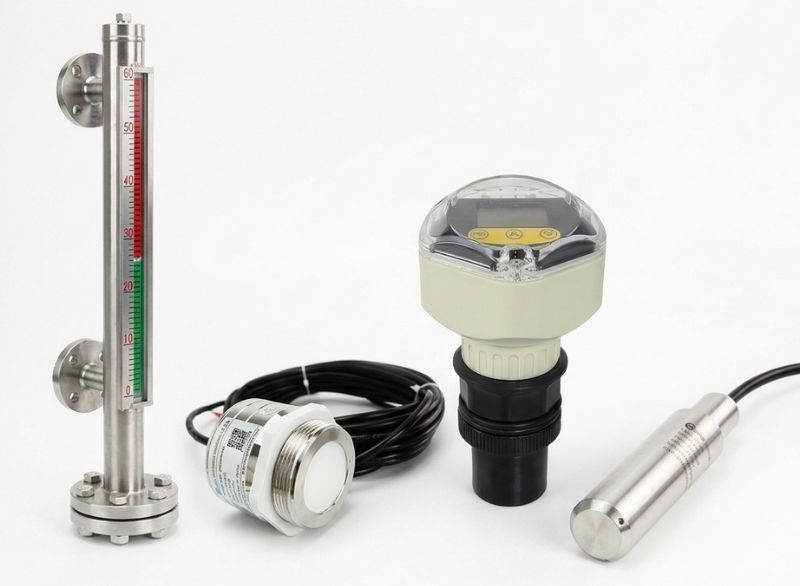
This piece walks you through the key categories, from point level switches to continuous measurement devices. We cover mechanical options and electronic solutions such as capacitive level switches and optical level switches. We’ll explore different liquid level switch types and help you choose the right technology for your specific application.
Level Switch Basics: Understanding the Technology
What Level Switches Detect
A level switch detects the presence or absence of a material at a specific point within a tank, vessel, or system. These devices work with liquids, solids, and powders and can even identify interfaces between different liquids. The switch changes state to control pumps, valves, or alarms at the time the material reaches a designated activation point.
The detection happens through several sensing methods. Float mechanisms use a buoyant element that rises or falls with the liquid and activates the switch through mechanical action. This proven method works well for clean water and non-corrosive liquids. Optical sensors rely on infrared light to detect liquid presence without moving parts. They are ideal for compact systems where you need to minimize mechanical wear.
Conductivity probes measure electrical resistance between electrodes. Changes in conductivity indicate liquid contact and make them practical for conductive fluids such as water-based solutions. Advanced technologies use capacitive, ultrasonic, or tuning fork methods for higher accuracy in challenging conditions like viscous, foamy, or high-temperature applications.
Contact vs Non-Contact Level Switches
Contact level sensors touch the media being measured, while non-contact sensors measure level from a distance. This difference affects performance, maintenance requirements, and application suitability.
Contact sensors include float switches, conductivity probes, and vibrating elements. They provide reliable measurements but face challenges in dirty applications where media build-up can affect performance. Debris and turbulence can damage contact sensors. The food and beverage industry faces contamination risks with contact sensors since they submerge into the product itself.
Non-contact sensors use ultrasonic or radar technology. Ultrasonic sensors emit sound waves that bounce off the target and return to the transmitter. The reflection time determines the level measurement. Radar sensors use electromagnetic waves, which are faster than sound waves and aren’t affected by temperature differences. This makes them more accurate than ultrasonic sensors.
Non-contact options stay above the material and require much less maintenance. They’re free from mechanical moving parts found in floats and probes, which reduces wear and tear from operation. Contact sensors vary in size and weight, with some level probes being long and heavy. These require lifts for tank installation. Non-contact sensors are small and lightweight, fitting into an NPT fitting of 3 inches or less.
How Level Switches Trigger Alerts
Level switches operate on a simple on/off mechanism. The switch either changes state or activates another device at the time the material touches it. The switch operates by opening or closing an electrical circuit to control connected equipment.
The circuit closes at the time electrodes contact liquid as the liquid completes the path for electricity to flow. The electrical current flowing in this circuit detects the liquid level. The switch signals a pump to turn off and prevents overflow if a liquid reaches a high point. It triggers a pump to turn on and ensures adequate supply if the level drops too low.
The output signal communicates with other system components such as alarms or control systems. Relay trip points are independently field configurable for liquid level, interface, or temperature operation. This mechanism can start filling a low tank, stop a pump to prevent dry running, or activate alerts to avoid overflow.
Mechanical and Contact-Based Level Switch Types
Mechanical switches rely on physical contact with the measured material to trigger state changes. These point level switches offer proven reliability in industrial applications of all types, from simple water tanks to high-pressure chemical vessels.
Float Level Switches
Float switches use magnetic force to operate without mechanical connections. The simple principle remains consistent: a buoyant float rises and falls with liquid level and activates a reed switch through magnetic attraction.
Reed float switches are set as either normally open dry or normally closed dry. Magnets pull the reed switch blades together as the float rises with normally open switches. This completes the circuit and allows power to flow. Normally closed switches work in reverse. The reed switch opens as the float rises and breaks the electrical circuit.
Mounting configuration affects operation. Horizontal float switches activate once rising liquid lifts the float enough to open or close the circuit. Vertically-mounted versions activate at specific levels based on liquid fluctuation above or below set points.
Single point switches provide reliable tank level detection in various sizes, mountings and materials. Multi-point switches monitor multiple liquid levels within a single tank. You can configure them with two to seven independent switch actuation levels. Custom float level switches offer up to seven different switch levels depending on series type.
Magnetic reed switches deliver years of trouble-free use. They work well for clean liquids, oils, fuels and chemicals. But liquids prone to deposits like lime or calcium can build up and cause float switch failure. They’re not suitable for viscous, dirty or coating liquids.
Displacer Level Switches
Displacer switches use a weight heavier than the liquid and suspend it by a spring. Buoyancy force changes the effective weight once liquid contacts the displacer. This causes the spring to retract to a new equilibrium position. The attraction sleeve moves upward into the external magnet field as the spring retracts. It overcomes the bias spring force and actuates the switching element.
Displacers remain partly or totally immersed in process liquid, unlike floats that ride above the liquid surface. This makes them more stable in turbulent, surging and foamy services. Displacers operate under higher pressure conditions than float switches.
Settings change with ease since displacers can shift anywhere along the suspension cable. You can accommodate process density differences by varying the spring tension. Testing displacer switches is simpler than float switches. You just lift the suspension rather than filling liquid to the actuation mark.
Paddle and Rotary Level Switches
Rotary paddle switches detect bulk solids in silos, bins and hoppers. A motor-driven paddle rotates at low speed. The resulting torque increase activates the switch once bulk material blocks the paddle.
These rugged devices handle flowing bulk solids up to a grain size of 50mm. They’re economical and require no calibration. The measuring principle suits simple applications with materials like grain, pellets and cement. They work in extreme conditions with process temperatures up to 1100°C and pressures up to 10 bar.
A spring resets the switch to its original position once bulk material no longer covers the measuring blade.
Diaphragm Level Switches
Diaphragm switches detect level through pressure changes. Air pressure inside the detection pipe increases as level rises. The diaphragm presses a micro switch and turns it on once pressure affects the diaphragm’s measuring face. The output contact returns to its original condition as level descends and air pressure decreases.
These switches work well for grains, feed, seeds and granular materials in mining, silos, hoppers and food applications. The flush mount design suits situations where vessel size, internal clearance or protrusion restrictions exist.
Electronic and Non-Contact Level Switch Types
Electronic sensors measure level through electrical properties or wave propagation rather than mechanical displacement. These point level switches work well where traditional mechanical methods face limitations.
Capacitive Level Switches
Capacitive sensors use capacitance measurement between two conductive surfaces separated by a dielectric material. The probe forms one electrode while the tank wall or reference electrode serves as the second, with the process material acting as the dielectric between them. Air has a dielectric constant of approximately 1, water around 80, and oils range from 2 to 5.
Material level changes alter the dielectric between electrodes from air to process media and change capacitance proportionally. The probe can be coated with PTFE or ceramic insulation for conductive liquids like water and acids, or use bare electrode structure for non-conductive materials such as oils and organic solvents.
RF admittance technology advances basic capacitive measurement by using radio frequency signals that measure both capacitance and conductance. This compensates for material coating on probes, a common challenge in sticky applications, by distinguishing actual level changes from buildup effects.
Optical Level Switches
Optical switches detect liquid presence through infrared light refraction. An infrared LED emits light into a prism at the sensor tip. Light reflects back to the phototransistor receptor when surrounded by air. Liquid contact with the prism causes light to refract into the liquid and reduces received light intensity, which triggers the switch.
These sensors respond within milliseconds and offer accuracy of +/- 0.5 mm. The compact design allows installation in process connections as small as 3/4″ tri-clamp, and autoclaving operations can be conducted up to 134°C. Detection remains independent of liquid density, dielectric constant, conductivity, or color. Coating or turbid liquids limit effectiveness since buildup on the prism interferes with light transmission.
Ultrasonic Level Switches
Ultrasonic sensors emit high-frequency sound waves that travel through air until striking the material surface. Sound waves experience substantial attenuation in air but transmit well through liquid. The sensor measures time for the echo to return and calculates distance using the speed of sound at 343 m/s at 20°C. Temperature and pressure affect measurement accuracy since sound waves are mechanical and require a medium to propagate.
Radar Level Switches
Radar sensors transmit microwave signals toward the measured surface and receive reflected signals that determine level. Operating frequencies include 6 GHz, 26 GHz, and 80 GHz, with higher frequencies providing smaller wavelengths and better resolution. Temperature and pressure do not affect measurements. The 80 GHz frequency offers smaller beam angles and better performance in vessels with internal obstructions.
Vibrating Level Switches
Vibrating switches use tuning fork technology with two prongs that oscillate at natural resonant frequency. Vibration frequency drops due to damping when liquid covers the forks. A piezoelectric element drives the fork and monitors frequency changes. These switches remain independent of electrical conductivity, dielectric constant, and product transparency. Battery-powered wireless models operate up to ten years at one-minute update rates.
Key Factors to Consider When Selecting a Level Switch
To match the right level switch to your application, you need to evaluate several technical parameters that affect performance and reliability directly.
Liquid vs Solid Material Characteristics
Material properties determine which sensing technologies will function properly. Liquid composition affects switch selection substantially. Clean water works with simple float switches. Liquids containing sediment, minerals or biological growth need materials resistant to fouling and corrosion, such as stainless steel or food-grade plastics. Viscous or coating liquids make solid-state sensors with no moving parts preferable since buildup compromises mechanical designs.
Chemical compatibility between wetted components and process media prevents premature failure. Stainless steel resists many corrosive chemicals but fails in wastewater applications where ferric chloride exists at substantial levels. Ceramic or epoxy-molded components work better in such environments. Specific gravity matters for float selection since buoyancy depends on liquid density relative to float material.
Environmental Conditions
Temperature and pressure define material and design suitability during operation. Process conditions determine whether standard or specialized constructions are needed. Sensors require careful selection when deposits build up on them.
Mounting and Installation Options
Side-mounted switches offer easy service access and work well for fixed installation points. Top-mounted options suit tanks where side wall access is limited. The space available within the tank influences mounting type selection.
Safety and Hazardous Area Requirements
Hazardous locations demand intrinsically safe or explosion-proof designs. Class I locations contain flammable gasses or vapors. Division 1 indicates continuous presence and Division 2 indicates intermittent presence. Required approvals include ATEX, UL and NSF depending on application.
Cost and Maintenance Considerations
Level switches present lower costs at the start and simpler installation compared to continuous measurement devices. Non-contact or external chamber types demand minimal attention once installed, making them suitable for remote sites.
Benefits of Using the Right Level Switch
Proper level switch selection delivers measurable improvements in safety, efficiency and cost metrics that affect your bottom line.
Preventing Overflow and Dry Run Conditions
Level switches provide immediate monitoring that prevents overflow situations. These situations lead to spillage or environmental hazards. The switch activates alarms or initiates shutdown procedures when liquid approaches maximum threshold. This stops inflow before disaster strikes.
There’s another critical function: protecting pumps from running dry. Dry running causes overheating and cavitation. Equipment damage results in costly repairs. Accurate detection will give pumps adequate liquid supply at all times.
Improving Process Efficiency
Automatic control eliminates manual monitoring. This reduces labor costs and minimizes human error. Immediate data enables informed decisions in dynamic environments where levels change faster.
Better material management makes resource optimization possible. Companies reduce waste and improve product quality when they maintain optimal levels. Processes run within ideal parameters without constant human intervention.
Reducing Maintenance and Downtime
Switches with no moving parts substantially lower maintenance requirements. This design reduces mechanical failure likelihood and extends service life in applications where uptime is critical.
Cost savings accumulate from preventing spills and avoiding cleanup expenses. Environmental violations bring fines that you can eliminate. Reduced operational disruptions offset the original investment and keep production schedules uninterrupted.
Conclusion
Choosing the right level switch for your application affects safety and your bottom line. Each technology has specific strengths tailored to different materials and conditions, as you’ve seen here. Float switches work well for clean liquids. Optical and capacitive sensors handle challenging environments where mechanical options fail.
Assess your material properties, environmental conditions and safety requirements before making your selection. The time spent matching technology to application pays off through reduced downtime and lower maintenance costs. It also ensures reliable operation. Choose the right switch and you make an investment that protects equipment and optimizes processes. This delivers long-term value.