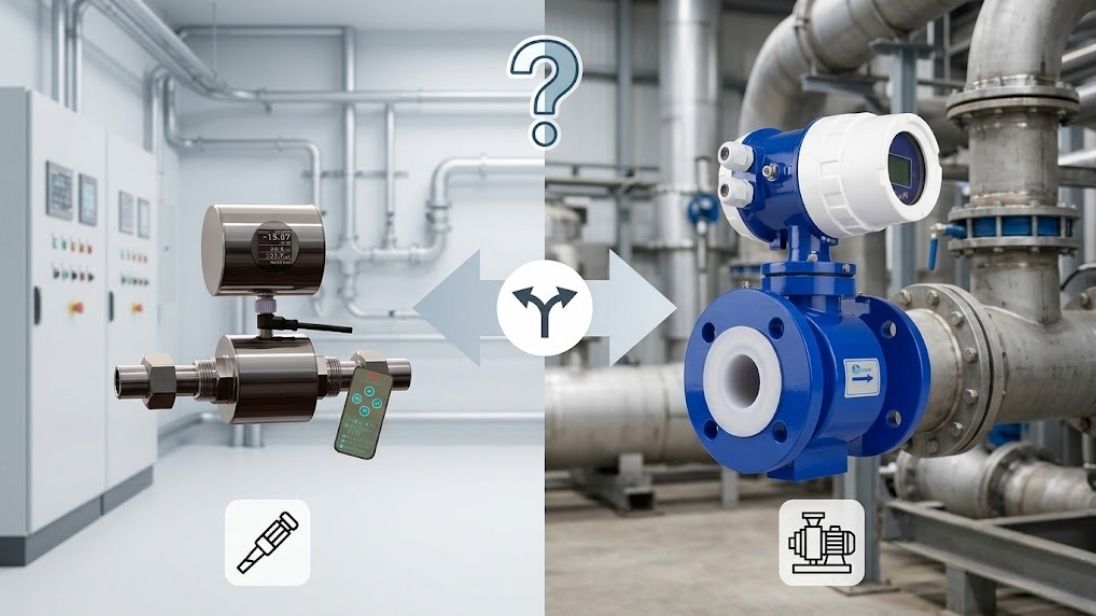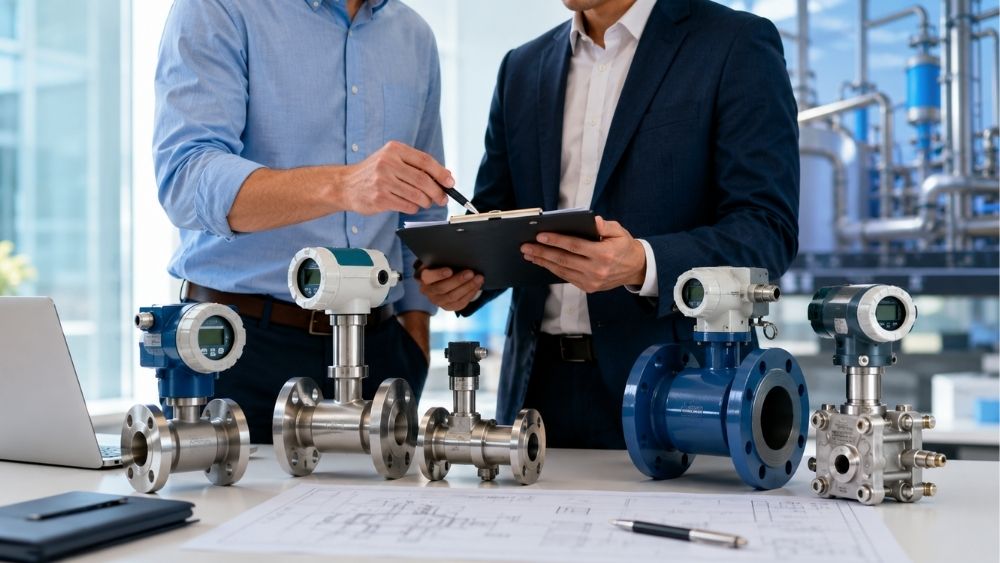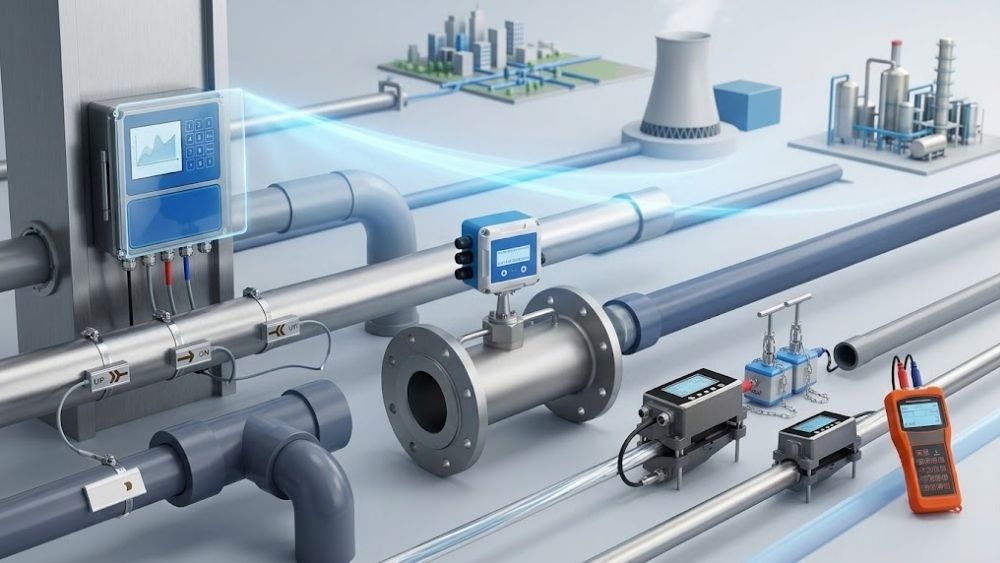
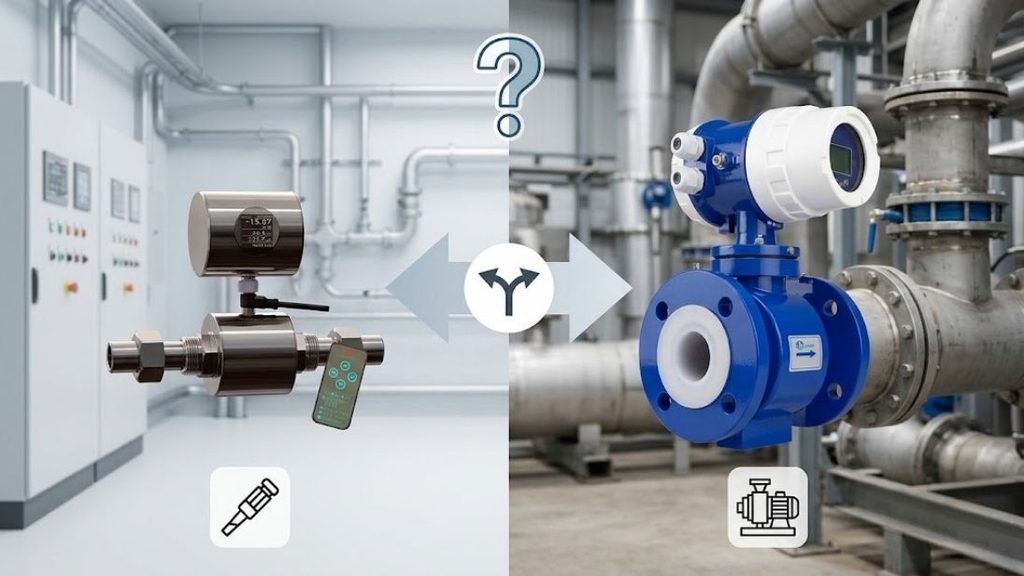
The right electromagnetic flow meter affects measurement accuracy and operational efficiency in your liquid handling systems. These devices support flow measurement in water, wastewater, chemical feed, and conductive process liquids. Magnetic flow meters provide accuracy up to ±0.2%. They feature an obstruction-free design with no moving parts. You might need a compact magnetic flowmeter for space-constrained installations. Or you might need a standard electromagnetic flowmeter for high-volume applications. Understanding the differences helps you match the right magmeter to your specific requirements.
What Are Electromagnetic Flow Meters and How Do They Work
Faraday’s Law Applied to Flow Measurement
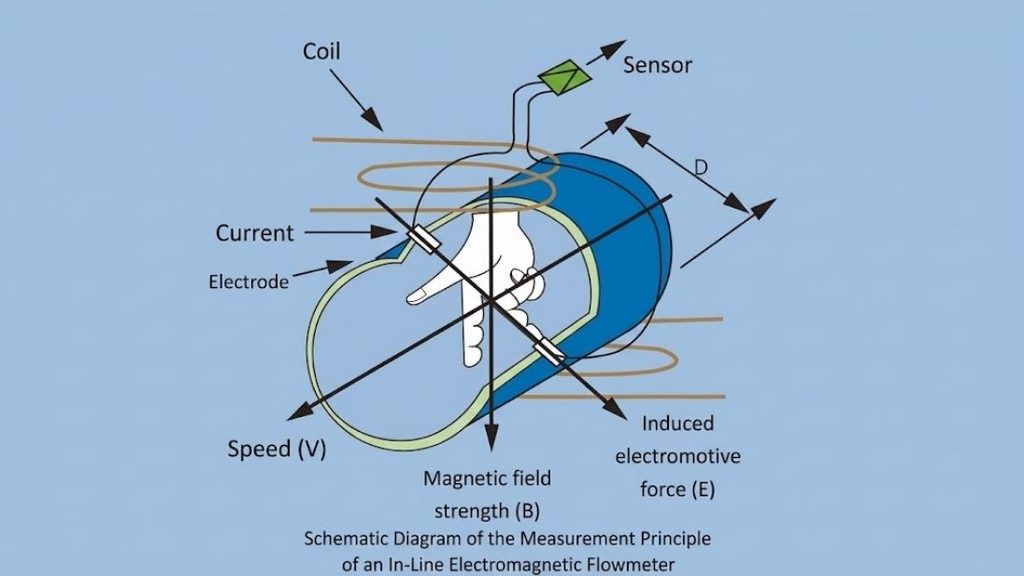
Electromagnetic flow sensors operate on a principle that English physicist Michael Faraday found between 1791 and 1867. Faraday realized that electric charges are induced in a conductive metal rod of length L moved at velocity v through a magnetic field B, so a voltage of a few millivolts is generated between the ends of the rod. This discovery remained unused for industrial applications until 1939. Swiss inventor Father Bonaventura Thürlemann pioneered the first practical magnetic flowmeter that year.
The induced voltage is proportional to both the velocity of movement and the strength of the magnetic field. The conductive fluid flowing inside the measuring tube corresponds to Faraday’s metal rod in flow measurement applications. Two field coils positioned on each side of the measuring tube generate a magnetic field of constant strength. Two electrodes on the inside pipe wall detect the voltage generated as fluid flows through this field.
The E=BVDK Formula Explained
The electromagnetic flowmeter formula expresses the relationship as E=BVDK. E represents the induced electromotive force, B denotes magnetic flux density, and V indicates the velocity of the conductive fluid. D measures electrode spacing (the inner diameter of the measuring tube), and K represents a coefficient related to magnetic field distribution and axial length. B, D, and K remain constant values or can be adjusted. The equation simplifies to show that induced voltage is proportional to fluid velocity.
Modern instruments like the FME800C employ ARM Cortex-M4 32-bit processors paired with 24-bit ADC data acquisition systems to process these signals. The sensor converts the induced electromotive force into a flow signal transmitted to the converter. The system displays instantaneous flow rate and cumulative flow on a backlit LCD screen after signal processing through amplification, conversion, and filtering.
Conductor Movement Through Magnetic Field
The flowing conductive liquid serves as the moving conductor in this measurement principle. Magnetic field lines pass through the entire cross-section of the pipe at a 90-degree angle to the flow direction. More voltage is generated at the electrodes as the fluid moves faster through these magnetic field lines. The measurement requires fluid conductivity greater than 2 μS/cm to function.
Adaptive variable-frequency excitation technology in advanced magmeters offers faster processing speeds and lower power consumption. The polarity of the magnetic field is reversed periodically. This produces consecutive measuring voltages with opposing signs at the electrodes. This pulsed DC field approach eliminates interference voltages from the calculation, namely electrochemical disturbances and power frequency interference.
Sensor Signal Conversion Process
The detected voltage signal undergoes conversion into standardized output signals through integrated electronics. The resulting measured voltage corresponds to average flow velocity, which multiplies by the known pipe cross-sectional area to calculate volumetric flow. Modern electromagnetic flowmeters provide outputs that include 4-20 mA current signals, RS485 MODBUS-RTU, frequency, pulse, and digital input/output channels.
The measurement remains unaffected by changes in fluid density, temperature, pressure, or viscosity. Flow profile has minimal effect on measurement results. This makes magmeters suitable for solid-liquid two-phase mediums such as slurries with suspended dirt, solid particles, or fibers. This independence from process variables distinguishes electromagnetic flow measurement from mechanical metering methods.
Key Characteristics of Compact Magnetic Flow Meters
Integrated Display and Rotation Features
Compact magnetic flowmeters eliminate the separation between sensor and display components found in traditional configurations. The FME800C integrates the sensor, PT100 temperature sensor, polysilicon pressure sensor, and converter into a single unit. This creates a space-efficient design with flexible installation options. The display rotates 90 degrees to match pipe orientation and will give consistent viewing angles whatever the installation position. This digital rotation capability means you don’t need different models when changing locations. The display adjusts on its own, independent of connection positions. Operators control the device using infrared remote control and connect to mobile apps via Bluetooth. This streamlines installation and setup procedures.
Variable-Frequency Excitation Technology
Advanced compact magmeters employ adaptive variable-frequency excitation technology. This delivers faster processing speeds and lower power consumption compared to conventional DC excitation methods. The polarity of the magnetic field reverses from time to time and produces consecutive measuring voltages with opposing signs at the electrodes. This approach eliminates electrochemical disturbances and power frequency interference from calculations. The sensor achieves higher accuracy while consuming less energy as a result. The ultra-low EMI power supply accommodates wide input voltage ranges with excellent electromagnetic interference resistance.
Multi-Parameter Measurement Capability
The FME800C measures instantaneous flow rate, temperature, and pressure at the same time within the same pipeline. This all-in-one capability stems from multiple ARM Cortex-M4 32-bit processors paired with 24-bit ADC data acquisition systems. The color LCD display shows various parameters including flow rate, velocity, cumulative flow, temperature, pressure, and output percentage. Changes in fluid density, viscosity, temperature, pressure, or conductivity do not affect measurements. The instrument handles conductive media with conductivity greater than 2 μS/cm and supports applications from clean water to liquid-solid two-phase mediums.
Self-Test and Diagnostic Functions
Built-in diagnostics provide continuous monitoring of both electronics and sensor hardware. Compact electromagnetic flowmeters include self-diagnostic functions such as empty pipe detection, excitation circuit fault detection, and flow alarm capabilities. Out-of-spec testing detects unexpected flow changes, linearity issues, and uncertain measurements. Continuous monitoring identifies leakages, contamination, liner deformation, and air entrainment in process liquids. Electrode circuit resistance monitoring detects anomalies such as isolation instantly. These verification functions save much expense by reducing labor and outsourced calibration service costs while eliminating process interruption.
PEEK Sensor Material Benefits
The sensor features an inner lining made of imported PEEK material. We selected it for its superior chemical resistance and thermal stability. PEEK withstands temperatures below 160°C while maintaining dimensional stability. The electrodes and PEEK lining undergo single-shot injection molding. This process will give consistency and reliability in production. This integrated formation process allows the instrument to operate under normal conditions even under negative pressure and offers excellent stability and reliability. The use of flexible-rigid printed circuit boards and surface-mount technology further ensures high circuit reliability.
FME800C Design and Assembly Patents
The proprietary technologies in the FME800C have yielded several self-developed results, covering single-injection molding processes and overall assembly methods. The unique fluid dynamics design eliminates straight pipe section requirements during installation. This model operates extensively in data center liquid cooling systems without issues at present. Multiple output options include RS485 MODBUS-RTU, IO-Link, 4-20 mA, frequency, pulse, and two digital input/output channels. You can modify instrument parameters online through Bluetooth, RS485, IO-Link, or infrared handheld controller. This provides flexibility for field adjustments.
Standard Electromagnetic Flowmeter Features and Specifications
Full-Scale Measurement Independence
Standard electromagnetic flowmeters maintain measurement accuracy irrespective of fluid temperature, pressure, density, and viscosity. The measuring principle operates independently of these process variables and makes these instruments reliable in a variety of industrial applications. Flow profile has minimal effect on measurement results. This independence allows a single calibration with water to be enough for measuring other conductive fluids without additional correction. The measurement remains accurate for bidirectional flow and captures both upstream and downstream movement. Standard magmeters achieve system accuracies of 0.2% at low and high volume flow rates, with diameters ranging from DN 2 to 3000.
Electrode Material Options and Formation
Electrode material selection affects measurement accuracy, durability, and fluid compatibility. The appropriate material choice depends on process conditions. 316L stainless steel suits potable water, industrial water, municipal wastewater, and organic acids with weak corrosive properties. Platinum demonstrates corrosion rates below 0.002 inches per year and operates in environments up to 120°C, though its 1.2-V electrode potential creates higher common-mode voltage that requires adequate rejection. Hastelloy B resists sulfuric acid, phosphoric acid, hydrofluoric acid, and non-oxidizing acids, while Hastelloy C handles oxidizing acids including nitric acid and mixed acids. Titanium provides excellent resistance to seawater, chlorides, hypochlorites, and oxidizing acids. Tantalum resists nearly all chemical media except hydrofluoric acid, fuming sulfuric acid, and strong alkalis. Tungsten carbide coated stainless steel addresses highly abrasive media such as mineral slurries and paper pulp.
Power Supply and Processing Systems
Standard flowmeters accommodate multiple power configurations. AC-powered units accept 100-240VAC at 50-60Hz, while DC versions operate on 18-36VDC or 22-26VDC ranges. Battery-powered options exist for remote installations. The electromagnetic flowmeter architecture divides into seven functional units: flow tube with field coils and electrodes, coil excitation unit that generates controlled magnetic field current, signal conditioning unit that translates electrode output into measurable signals, processing unit that provides control signals and flow calculations, IO interface supporting multiple protocols, user interface with LCD and keypads, and power supply unit that determines measurement quality.
LCD Display and Parameter Adjustment
The converter displays flow rate, cumulative flow, flow velocity, percentage, and system alarm messages on LCD screens. Parameter adjustment occurs through keypad controls or infrared sensors depending on model configuration. The display shows positive flow accumulation, negative flow accumulation, net flow accumulation, current flow rate, and conductivity measurements. Users access five password levels for parameter modification, with levels 0-3 open for operators and level 4 reserved for manufacturers.
Circuit Board Design Technology
Mixed signal design is the most critical element in standard magmeters. The signal conditioning circuit rejects common mode voltages, amplifies low-level electrode signals ranging from a few microvolts to a few millivolts with dynamic range over 1,000, filters DC components, and shifts levels to identify flow direction. First-stage gain ranges from 10 to 20 to amplify signals while keeping DC offset small. Overall gain spans 450-600 and is implemented across two or three amplification stages.
Output Signal Configurations
Standard electromagnetic flowmeters provide 4-20mA current output, RS485/RS232 serial communication, pulse output, frequency output ranging from 1 to 5000 Hz, and relay outputs for alarm conditions[142]. The current loop communicates over long distances without voltage drop interference. Digital outputs include photoelectric isolation exceeding 1000VDC. Maximum output capacity reaches 36V DC with 250mA current for pulse and frequency signals.
Compact vs Standard: Performance and Application Comparison
Space Requirements and Physical Footprint
Compact magnetic flowmeters excel in space-constrained environments where traditional installations prove impractical. Standard electromagnetic flowmeters separate the sensor from the transmitter and require additional mounting hardware and conduit runs. Integrated compact designs reduce installation footprint substantially in contrast. The FME800C combines sensor, temperature sensor, pressure sensor, and converter into a single unit and eliminates external wiring between components. Available in 1″ and 2″ sizes, compact models suit rack-level cooling circuits and subsystem applications. Standard magmeters span DN 2 to 3000 and serve large-diameter primary loops and high-volume industrial processes.
Measurement Accuracy and Turndown Ratios
Magnetic flowmeters deliver turndown ratios between 20:1 to 100:1 and exceed differential pressure meters limited to 3:1 to 10:1. Some electromagnetic flowmeters achieve 125:1 turndown and maintain accuracy in variable flow conditions. Standard magmeters reach ±0.2% accuracy, suitable for custody transfer and precision metering. Compact versions achieve ±0.5% accuracy, adequate for monitoring and control applications. This rangeability proves critical in data center cooling where flow varies between startup, peak load, and low-demand periods.
Installation Complexity and Straight Pipe Needs
Traditional electromagnetic flowmeter installation requires five pipe diameters upstream and two downstream to stabilize flow profiles. Close-coupled elbows and valves disrupt symmetry and create accuracy shifts. The FME800C eliminates straight pipe requirements through proprietary fluid dynamics design and operates in data center liquid cooling systems reliably. Standard meters demand 10D to 20D upstream spacing near pumps and increase piping costs in retrofit applications. Zero straight run capability reduces installation time and modifications in building design constraints.
Fluid Properties’ Impact on Selection
Electromagnetic flowmeters require minimum conductivity between 5 to 20 μS/cm, around 10⁻⁴ S/cm to 5×10⁻⁶ S/cm. Compact meters with PEEK linings handle temperatures below 160°C. Standard units with PTFE linings accommodate corrosive chemicals. Electrode materials vary by application: 316L stainless steel suits municipal water, titanium resists seawater and chlorides, and tantalum withstands most acids except hydrofluoric acid.
Data Center Cooling System Applications
Liquid cooling delivers 3,000 times greater heat removal effectiveness than air cooling for high-performance computing infrastructure. Direct-to-chip cooling requires 1 to 2 liters per minute for cold plates. Rack-level flows reach 30 to 60 L/min, and main supply lines handle up to 250 L/min. Compact magmeters with deactivated wireless connectivity meet facility security policies while monitoring inline flow and temperature. Standard Rosemount 8795 meters serve primary cooling loops, while Picomag variants integrate into rack-level modules.
Industry-Specific Use Cases
Water and wastewater treatment facilities deploy standard magmeters for large-diameter monitoring and EPA discharge reporting. Chemical processing plants select corrosion-resistant electrode configurations for acids and alkalis. Mining operations measure abrasive ore slurries with ceramic-lined sensors. Food and beverage applications require hygienic designs with CIP/SIP cleanability. Compact electromagnetic flowmeters serve HVAC systems, chiller makeup water, and sub-metering applications where space limitations prevent traditional meter installation.
How to Choose Between Compact and Standard Magmeters
Evaluating Your Process Requirements
Application specifics determine meter type selection. Fluid characteristics including temperature, flow range, and pressure guide your decision. Conductivity requirements above 5 μS/cm suit both designs, but corrosive chemicals demand specific electrode materials: stainless steel for municipal water, Hastelloy for acids, titanium for seawater applications. Flow range and expected velocity fluctuations influence whether turndown ratios become critical factors.
Pipe Diameter and Flow Velocity Analysis
Match meter size to actual flow conditions rather than pipe diameter alone. Calculate velocity at minimum and maximum flow rates. Water applications operate between 1-3 m/s, while slurries benefit from 3-4 m/s to prevent deposition. Reduce velocity to 1-2 m/s to minimize liner wear with abrasive fluids. Reducers accommodate smaller meters in oversized pipes, though this introduces pressure loss considerations.
Budget Considerations and Total Cost
Costs vary from $200 to $5,000 depending on pipe size and accuracy requirements. Higher accuracy delivers ROI through improved measurement. Standard process accuracy of ±0.5% suits most applications, while ±0.2% precision doubles costs.
Environmental and Operating Conditions
Protection ratings affect longevity: IP65 handles water spray, IP67 withstands brief immersion, and IP68 makes continuous submersion possible. Temperature ranges and vibration conditions influence model selection. Grounding requirements and electromagnetic interference need evaluation.
Maintenance and Serviceability Needs
Access to inspect electrodes and clean liners determines long-term serviceability. Compact designs reduce wiring isolation issues but may limit field servicing. Plan monthly grounding inspections, quarterly electrode cleaning, and annual recalibration.
Conclusion
Selecting between compact and standard electromagnetic flowmeters depends on your specific application requirements, installation constraints, and budget. Compact models like the FME800C deliver exceptional value in space-limited environments, especially with their zero straight pipe requirements and multi-parameter measurement capabilities. Standard magmeters remain the preferred choice for large-diameter piping and high-precision custody transfer applications.
Take the case of data center cooling systems, where compact meters operate without installation complications. Assess fluid characteristics, pipe diameter and long-term maintenance needs before you make your decision. The right selection will achieve accurate flow measurement and optimize both installation costs and operational efficiency in your liquid handling systems.